
A series of 41 essays on one question: how can people, organizations and nations turn increasingly capable AI into greater human capability, better services and sustainable economic opportunity?
I did not work out my answers at a desk. They come from volunteer AI workshops with public officers across Sri Lanka, from using these tools every working day, and from a reference architecture I have proposed for an AI-first agentic digital economy. That architecture is my proposal, not an adopted standard, and I say so wherever it appears.
The argument runs in a line. AI becomes useful when people can say what they need, judge what comes back and keep the authority to decide. A motivated person still needs an enabling environment: language, connection, tools, somewhere to run what they build, permission and support. And a citizen never experiences a task, only the whole service, including what happens when it goes wrong.
So the essays move from national direction, to language and capability, to business and work, and then to the foundations, the trust and the sector outcomes that make delivery possible.
How should you read it? In order, if you can: each essay builds on the one before. If you came with a specific question, start with the Part that holds it.
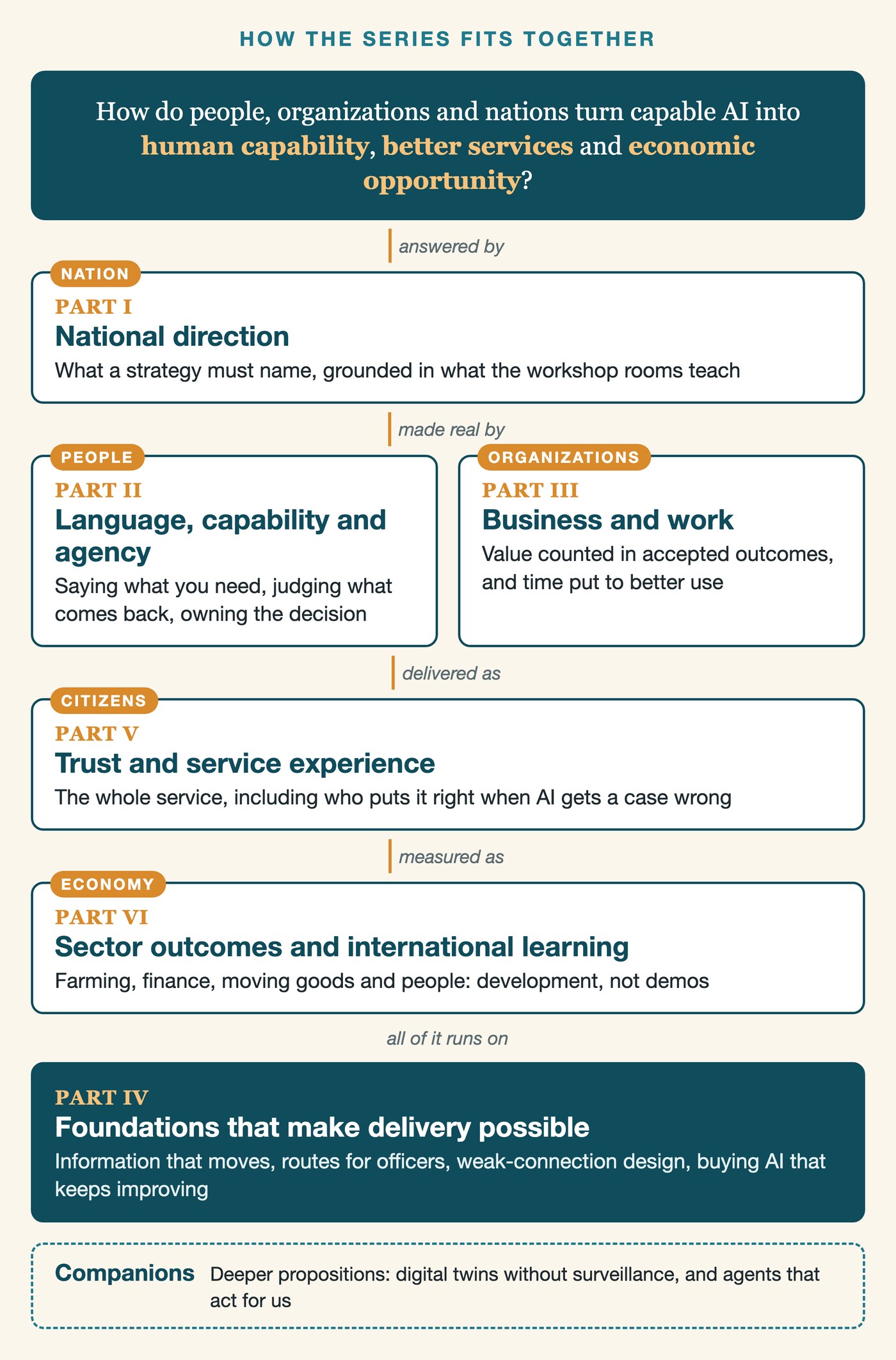
Part I — National direction grounded in experience
- What I Am Learning While Teaching AI Across Sri Lanka
The gap is not awareness. It is language, connection and somewhere to run what officers build. - What Should a National AI Strategy Be?
Which outcomes will improve, through what mechanisms, at what cost, and under whose responsibility. - Designing an AI-First Agentic Digital Economy for Sri Lanka
My proposed reference architecture, traced through one permit request. - An AI-Ready Nation Gives People the Means to Act
Readiness belongs to a task inside an institution, not to a person or a nation. - A National AI Conversation That Changes What Gets Built
Being heard is easy to arrange. Something changing is the only thing worth asking people to travel for.
Part II — Language, capability and agency
- Why Human Language Knowledge Matters More in the AI Era
Fluency is not meaning: articulation, interpretation and official terminology as AI skills. - Who Still Cannot Use an AI-Enabled Service?
Inclusion is the person obtaining the outcome, assisted routes included. - Which AI Capabilities Should Sri Lanka Build and Sustain?
Build, adapt or buy, and the year-three test: who maintains it, from which budget. - What Should an AI-Ready Learner Be Able to Demonstrate?
AI-assisted work, plus the ability to explain it, verify it and answer for it. - From Task Execution to Mission Ownership
Five proposed stages of agency at work, and a self-assessment that is a mirror, not a score.
Part III — Business and work
- Where Does AI Value Appear in the Business?
Value appears only when accepted outcomes improve after every delivery and operating cost is counted. - Leading an Organization That Can Delegate to AI
Delegation does not reduce the need for management. It concentrates it. - Moving AI from a Successful Pilot into Everyday Operations
A working pilot still needs integration, ownership, support and economics that last. - An Agent Factory Must Produce Reliable Outcomes
A repeatable way to deliver and maintain bounded capabilities, judged by completed work. - An Agent Is Not Done When It Works
The real work starts the morning after launch: who finds out first when it stops being right? - What Should We Do with the Time AI Gives Back?
A faster task is not a shorter week. Released time needs a named owner.
Part IV — Foundations that make delivery possible
- Let Information Move So Citizens Do Not Have To
Shared platforms earn their value only when a citizen’s day gets shorter and nobody loses a right. - When the Record Is Wrong, a Person Waits
A missing record or two registries that disagree: the cases off the happy path are where citizens wait. - Give Public Officers a Practical Route from AI Use to Service Improvement
One bounded task, an approved place to work, a named owner and a review date. - An Officer Can Build an App. Who Helps It Become a Public Service?
The missing piece is a published route and a named owner more than new hardware. - Before 6G, Can the Service Survive a Weak Connection?
Service design starts with finishing the task reliably, not with buying a newer network. - Match the Network to the Work, Not to the Generation
A generation is not a requirement: name what the work needs before choosing the network. - Buying AI That Can Improve After the Contract Is Signed
Write staged evidence, operating obligations and a practical exit into the contract at purchase.
Part V — Trust and service experience
- When AI Gets Your Case Wrong, Who Puts It Right?
A person wronged by an automated decision is owed the evidence, a named person who can reverse it, and a route they can afford. - Governing AI from Data Access to Authorized Action
Start with a register of what is running and who owns it, then write the lawful basis and the authority as two separate lines. - Who Answers When the Model Changes
When a supplier changes the model behind a live service, a named person must answer for it and be able to stop it. - What Could an AI Assistant Do with the Access We Give It?
Bound what an assistant can do, keep instructions apart from data, and plan the recovery for when prevention fails. - Personalization Should Make the Customer’s Life Easier
Judge personalization by whether the problem got resolved and whether the customer holds a control they can use. - Three Journeys That AI Should Make Easier
A certificate, a trip and an appointment: one bounded job for AI in each, and what each one waits on. - What a Shared Platform Cannot Share
Share the foundation, and keep language, human escalation, accessibility and failure handling owned in each domain.
Part VI — Sector outcomes and international learning
- Reducing the Cost of Moving Goods and People
Useful AI in logistics depends less on the optimiser than on the data events other parties hold, and on an agreement that prices sharing them. - Does Agricultural AI Help Farmers Earn More and Lose Less?
Advice is worth funding only when it is locally valid and connected to markets, resources and trusted support, and a trial measures net income. - AI in Finance Must Improve Access and Preserve Trust
Sort each use case first, and give a named person the power to lift a wrong payment hold the same day. - More Data Is Not a Fairer Decision
Consistency is not fairness, a generated explanation is not the reason, and the figures that would settle it are complaints nobody outside can see. - Global AI Lessons Sri Lanka Can Actually Use
Three cases from India, the United States and China run through seven questions: none transfers whole, and each leaves a list. - Measuring AI by the Development It Delivers
Start from a named need, borrow official indicators, and write the baseline down before the money moves. - Who Bears the Cost of a Project That Works
The costs nobody asks about, the people missing from the denominator, and a retirement trigger written before launch.
Still to come
- Companions. Coming next: national intelligence and digital twins without a surveillance machine, and what happens when agents act for us in the economy.
I add each essay here as it goes live.

