AI, Human Agency and the Digital Economy · Part 2 of 41
What a national AI strategy has to name, what the countries further down this road actually do, and what a citizen should be able to expect from it.
Picture three people hearing the same phrase this week: a national AI strategy.
A woman in a district town wants an answer from a government office, in Tamil, without making the journey twice.
A man with a two-person business — he is the sales team, the delivery team and the accounts clerk — wants the paperwork around getting paid to stop eating his Sundays.
The state wants a third thing: services that cost less to run, earnings that arrive in foreign currency, a government that delivers what it announces.
None of them will read the document. All of them will be told it is good news.
What follows is not a review of any particular document. It is the test I would apply to any national AI strategy, including whichever one we adopt — and a question about what those three people should be able to expect from it.
What should a national AI strategy be?
Not a list of technologies. Not a vision of where we would like to be by 2030.
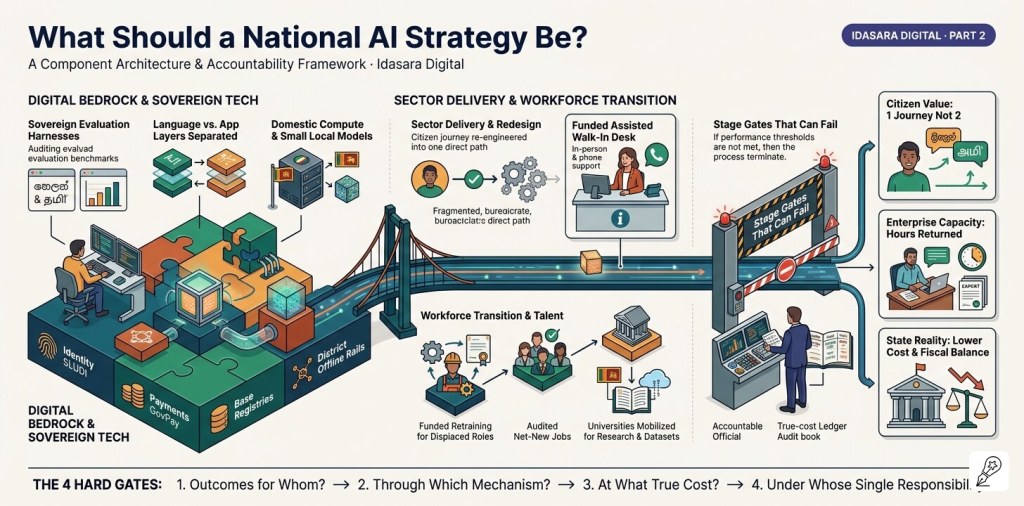
A useful strategy explains which outcomes will improve, through what mechanisms, at what cost, and under whose responsibility. Answer those four and you have a plan. Miss them and you have a vision statement with a technology list attached.
Take them one at a time.
Which outcomes, and for whom. For a citizen, value is a service that works: the answer arrives, in the language you asked in, with a human route when the machine is wrong. For an enterprise, it is capacity — work you could not afford to do before, and can now sell. For the state, it is delivery and fiscal reality: cost per citizen served, or earnings the Treasury can bank.
Those are three different things. Write them down separately and you can no longer claim all three with one cheque.
The government’s Digital Economy Blueprint, undated on the document itself (the PDF was created on 2 December 2025), sets out an ambition to grow the digital economy to USD 15 billion and digital exports to USD 5 billion. That is the government’s ambition, not mine, and I will not forecast against it.
Through which mechanism. An outcome named without a mechanism is a wish. There are five doors: productivity — where released time is deliberately redeployed rather than quietly absorbed — then new products, exports, service access, and household opportunity.
Exports is where we have a baseline rather than a hope. The Export Development Board’s estimate for ICT and business-process exports in 2025 was USD 1,644.83 million, larger than tea at USD 1,507.19 million.
The national accounts carry the uncomfortable one. On the Central Bank’s provisional 2025 balance of payments, computer-services exports fell from USD 848 million to USD 800 million in a single year, while imports of the same services rose from USD 194 million to USD 263 million. That is one year of provisional data with 2024 revised, not a trend. But a strategy that cannot say which of those two lines it is trying to move is not yet a strategy.
What the strategy has to name
The four questions test how a strategy is written. They do not say what it must cover. Here is what I would look for in the contents page, and what we get from each one being there rather than assumed. None of it is exotic. All of it is routinely left out.
What the strategy must nameWhat we gain from it being in thereOur own models — and the harnesses to judge themNot only which models we buy, but the test sets, evaluations and benchmarks that tell us whether one works here. Without a harness we cannot check a supplier’s Sinhala or Tamil claim. With one, every procurement gets an evidence standard and switching becomes possible.Language capability and application capability, separatelyMaking a model speak Sinhala is one problem. Building a service on top of it is a different one, with different skills and different money. Funded as a single line, the second silently goes unfunded, and a working translation layer gets mistaken for a working public service.AI-first government, or AI bolted onSay which it is. Redesigning a service around what AI makes possible is a different programme from adding AI to the process we already run. Left unnamed, we buy the second and report it as the first: cheaper versions of the same bad journey.A plan for the work that goes awayWhich roles are exposed, in which sectors, on what timescale, and who pays for retraining. A strategy that cannot say this cannot be defended in public, and the people affected learn it from a headline instead of from their employer.A plan for the work that appearsWhich new roles the strategy intends to create, where, and roughly how many, stated as an intention that can later be checked. An employment claim nobody can audit is not a benefit. It is a slogan.Local data centres and smaller modelsWhere compute physically sits, and where a smaller model run locally beats a frontier model billed by the token. This is the difference between a pilot that dies at its first invoice and a service that still works on a weak connection in a district office.AI embedded in sector strategies, not beside themHealth, agriculture, education, revenue and transport each owning their AI work inside their own plans, with their own budget lines and their own owners. A separate AI strategy sitting alongside them belongs to nobody in particular.The digital enablers AI needs in order to actIdentity, payments, records, addressing, consent, e-signature. An agent cannot act without rails. Named once and shared, every later investment stops paying to rebuild the same plumbing.Security, ethics and technical failure as budget linesThe failure modes written down, with who monitors them, who can switch a system off, and what that costs. Risk that is named gets funded. Risk that is assumed gets discovered by a citizen.The execution engine, distinct from the planningWho delivers, with what authority, what staff and what budget — as a body, not a document owner. Most strategies name an author and leave delivery to institutions that were never given the power to do it.Universities and education institutes, mobilised by nameGive them the work: evaluation, local-language datasets, curriculum, the talent pipeline. Bought abroad, capability leaves when the contract ends. Built here, it compounds and stays.
Every row above is a claim someone has to own. Which brings the four questions back: named outcome, named mechanism, named cost, named owner — for each line of the contents page, not only for the strategy as a whole.
What are other countries doing?
The instinct is to look at who has the biggest models. I think that is the wrong place to look, because it is not the part we could copy even if we wanted to.
What is worth copying is duller and cheaper, and the countries further down this road are the ones that built the habit of checking.
The United Kingdom’s National Audit Office published an examination of its own government’s use of AI in March 2024 — a national auditor, looking at the state’s own deployments, in public. Its central finding was not about technology. It was about readiness: bodies piloting far more than they were operating, and a shortage of the basic management information needed to know which was which.
The same government publishes the projects that are going badly. Its major projects report names red-rated programmes in its own portfolio, annually, while they are still red. And its Treasury writes appraisal, monitoring, evaluation and publication into standing guidance — the Green Book — so that the checking is a rule rather than a virtue.
The distinction worth taking from all of that is between having a process and using one. A country can adopt every appraisal step on paper and still not apply them, and the difference only ever shows up in what gets published afterwards.
Two other findings from abroad are worth holding onto, because both are measured rather than asserted. The UK competition authority’s 2025 cloud market investigation found that fewer than 1% of customers switch provider in a year, with egress fees and non-transferable staff skills among the barriers. And Eurostat’s 2025 figures show 17% of small firms using AI against 55% of large ones — in a survey that only covers enterprises with ten or more people.
So the pattern, across the places that are ahead of us: they appraise before they build, they publish what is not working while it is still not working, they measure lock-in instead of assuming it away, and they find adoption is uneven by firm size no matter how good the strategy is.
None of that requires a frontier model. All of it requires a habit.
And one caution about importing lessons at all. The World Bank said it plainly ten years ago, about digital technology rather than AI: digital dividends have lagged, and “their aggregate impact has fallen short and is unevenly distributed”. Daron Acemoglu’s task-based model of AI exposure in advanced economies points the same way — a ceiling of no more than a 0.66% rise in total factor productivity over ten years. That is a modelled ceiling under stated assumptions, not a measured outcome, and it is not about Sri Lanka.
What does it cost, and who holds the other end?
Everything worth doing here buys something from abroad. We already pay for imported know-how: on the provisional 2025 accounts, payments abroad for the use of intellectual property were USD 165 million against USD 12 million received. Any portfolio also competes inside an envelope — capital expenditure and net lending was 3.0% of GDP in 2025, provisional. I am not going to turn that into a number for AI.
Dependence is a dial, not a fate. Given the switching figure above: control where it is genuinely required, portable records, stable interfaces, and a written answer to what is stranded when we change supplier. And one cost nobody budgets — review labour. Someone qualified checks the output before it reaches a citizen. That is a salary line, not a rounding error.
A sheet to fill in before the next announcement
Two words will appear in whatever strategy we publish: inclusive and citizen-centric. Both are easy to write and neither survives contact with a budget unless someone turns them into things that can be counted. So this is the part I would argue hardest about — not whether we want them, but how a document makes them happen.
How a strategy becomes inclusive
Inclusion fails quietly. It fails in the average.
Start where the difficulty actually is. A third of the employed in Sri Lanka are own-account workers and 57% of employment is informal, on the 2024 Labour Force Survey. Eurostat found 17% of small European firms using AI against 55% of large ones — and that survey does not even cover firms with fewer than ten people, which is where most of our economy lives. If adoption is uneven among registered European firms with staff, it will be more uneven here, not less. A pilot that reaches registered businesses with an accountant has reached the easy half and learned nothing about the other one.
Five things make the difference, and all five can be written into a strategy:
Name the person least able to use the service, and keep the row true for her. Not “citizens”. One person — the one with the oldest phone, the weakest signal, the least written Sinhala or Tamil, nobody at home who can help. If the design only works for everyone else, it is not inclusive, it is popular.
Publish accuracy separately for Sinhala and for Tamil. An aggregate number hides the language that is failing, every time. If the two are not published apart, the service has not been tested — it has been demonstrated.
Fund the assisted route as a line item, on day one. Someone will telephone. Someone will walk in. Someone will send a relative with permission to act for them. An assisted channel that appears in year three, unfunded, is a channel that never appears.
Disaggregate every published measure — by language, by district, by assisted versus unassisted. A national average is the most reliable way to lose the people a strategy is supposed to find.
Design for the worst connection, not the average one. A national subscription density cannot tell you whether the work can be finished in one room on one morning. If the process stops when the connection drops, the service excludes whole districts on a bad week.
How a strategy becomes citizen-centric
Citizen-centricity fails differently. It fails by describing the office instead of the person.
The OECD puts the shift more crisply than I do, on evidence from its member administrations: “Rather than automating existing processes, AI can be part of a redesign towards integrated, citizen-centred public services.” Automating the form we already have is not the same as asking whether the form should exist.
Four rules make that operational:
Start from the journey, not the task. A citizen never experiences a task. She experiences the whole thing — the form, the record, the approval, the exception, and what happens when it goes wrong. A strategy that funds tasks will deliver faster steps inside a journey that is still three visits long.
Take the baseline from her side, before anything is built. Not system uptime. How many journeys, how many documents, how many days, how many offices. If nobody measured that first, no one will be able to say later whether it improved.
Name the exception path and the recovery path. What happens on the bad day, who answers, and how a wrong decision gets put right. Every service has a bad day. Most designs only describe the good one.
Put the owner where the citizen feels the failure, not where the technology is bought. The person accountable should be the one a complaint naturally reaches.
Then fill in the columns
Which brings back the fourth question — responsibility. An accountable owner has four properties: a named budget, a published baseline taken before anything is built, a stage gate the investment can fail, and a duty to report the failure. Remove one and you have a sponsor, not an owner. I name no institution here, because ownership is a property, not a logo. And none of this is my invention: screening, appraisal, independent review and published evaluation are ordinary public-investment practice, written into a treasury green book, an Overseas Development Institute guide for capacity-constrained finance ministries, and the annual reports governments publish on their own projects.
So the sheet below is not a summary. It is the form on which the two words stop being adjectives. The beneficiary column forces one named person. The baseline column forces a measurement taken from her side. The measure column forces disaggregation and publication. The last column forces someone to be able to fail.
Three illustrative rows, filled in honestly. The measure column says what would be measured, never what was achieved.
BeneficiaryMechanismBaseline todayWhat gets measured and publishedWho fails the gateA person needing a state answer in Sinhala or TamilService accessSinhala and Tamil datasets: stated intent, not a delivered assetEnquiries answered correctly in the language asked, reviewer-checked, quarterlyThe service owner: named budget, a review it can fail. Fails unless Tamil and Sinhala accuracy are published separately; below threshold, no scaling. Exit: data and test sets publicly owned, a second supplier testableA one-person business doing its own invoicingProductivity · household opportunity33.1% own-account workers; 56.9% of employment informal (Labour Force Survey 2024)Micro-enterprises completing the workflow unaided, by district, annuallyThe shared rail’s owner, not the pilot’s. Fails without uptake among businesses that had no software before. Exit: records exportable in a standard formatA services exporter selling language and content workExportsComputer-services exports USD 848 mn (2024, revised) to 800 mn (2025, provisional), Central BankEarnings in the baseline’s own published series, annuallyThe export-promotion budget holder. Fails on pilots without repeat contracts. Exit: skills and data held by the firms, not one platform
Take the investment nearest to you and fill in a row. If you cannot fill it, you have not found a bad investment. You have found one nobody has yet been asked to explain.
The teaching behind it is open to read at Idasara Academy’s AI Hub.
This series exists to ask one question: how can people, organizations and nations turn increasingly capable AI into greater human capability, better services and sustainable economic opportunity? A national strategy is that question answered in public, with a budget and a name attached.
Well — whose name is on the one nearest you?
Second of 41 essays on AI, human agency and the digital economy; the next goes underneath, to the architecture.
Next in this series: A03 — Designing an AI-First Agentic Digital Economy for Sri Lanka
All essays in this series: AI, Human Agency and the Digital Economy
At a glance
- My test for any national AI strategy: it must name which outcomes will improve, through what mechanisms, at what cost, and under whose responsibility. Miss one and it is a vision statement with a technology list attached.
- Eleven things the contents page has to name, each with what we gain from it being there: our own models and the harnesses to judge them; language capability and application capability funded separately; whether government is AI-first or AI bolted on; a plan for work that goes away and work that appears; local data centres and smaller models; AI embedded in sector strategies rather than beside them; the digital enablers agents need in order to act; security, ethics and technical failure as budget lines; an execution engine distinct from the planning; and universities mobilised by name.
- What the countries further ahead actually do: appraise before building, publish what is not working while it is still not working, measure lock-in rather than assume it away, and accept that adoption stays uneven by firm size. The UK’s national auditor examined its own government’s AI use in 2024; the same government publishes its red-rated projects annually; its Treasury writes evaluation into standing guidance. None of it requires a frontier model.
- Measured cautions from abroad: fewer than 1% of cloud customers switch provider in a year (UK CMA, 2025); 17% of small EU firms used AI in 2025 against 55% of large ones, in a survey that excludes firms under ten people. Sri Lanka’s typical enterprise sits below that floor — a third own-account workers, 57% informal employment.
- How a strategy becomes inclusive, in five things that can be written into a document: name the person least able to use the service and keep the design true for her; publish Sinhala and Tamil accuracy separately; fund the assisted route as a line item on day one; disaggregate every published measure by language, district and assisted-versus-unassisted; and design for the worst connection, not the average one.
- How a strategy becomes citizen-centric, in four rules: start from the journey rather than the task; take the baseline from the citizen’s side before anything is built; name the exception path and the recovery path; and put the owner where the citizen feels the failure, not where the technology is bought.
- An accountable owner has four properties: a named budget, a baseline published before anything is built, a stage gate the investment can fail, and a duty to report the failure. Remove one and you have a sponsor, not an owner.
- What a citizen should gain, stated as three illustrative investments: one journey instead of two for a state answer in Sinhala or Tamil; hours returned to a one-person business; repeat contracts rather than pilots in language and content exports. None promises a percentage of GDP, a job count or a ranking.
- A five-column assessment sheet — beneficiary, mechanism, baseline today, what gets measured and published, and who fails the gate — to fill in before the next announcement.
Questions people ask
What should a national AI strategy be? It should explain which outcomes will improve, through what mechanisms, at what cost, and under whose responsibility. Those four questions are the whole test. A document that names technologies and targets without naming mechanisms, costs and an accountable owner is a vision statement, not a strategy.
What must a national AI strategy actually cover? Eleven things belong on the contents page: our own models and the evaluation harnesses to judge them; language capability and application capability budgeted separately; an explicit choice between AI-first government and AI bolted onto existing process; a named plan for jobs displaced and jobs created; local data centres and smaller models; AI embedded inside sector strategies; the digital enablers — identity, payments, records, consent — that agents need in order to act; security, ethics and technical failure written in as budget lines; an execution engine distinct from the body that writes the plan; and universities and education institutes mobilised by name. Each item still has to answer the same four questions.
What are other countries doing about AI strategy? The useful part is not the size of their models. It is the habit of checking. The UK’s National Audit Office published an examination of its own government’s AI use in March 2024, finding far more piloting than operating and too little management information to tell them apart. The same government publishes its red-rated major projects annually, and its Treasury writes appraisal, monitoring and evaluation into standing guidance.
What should citizens gain from a national AI strategy? Three concrete things, not percentages: an answer from the state in the language you asked in, on one journey instead of two, with a human to escalate to when the machine is wrong; hours returned to a one-person business through the paperwork around getting paid; and better-paying work in language and content services, measured as repeat contracts reported against the same baseline. If Tamil accuracy is not published separately from Sinhala, the service has not been tested — it has been demonstrated.
How do you make a national AI strategy inclusive and citizen-centric? By turning both words into things that can be counted. For inclusion: name the person least able to use the service and keep the design true for her; publish Sinhala and Tamil accuracy separately, because an aggregate hides the language that is failing; fund the assisted route — counter, telephone, a relative acting with permission — as a line item on day one; disaggregate every published measure by language, district and assisted versus unassisted, because a national average is the most reliable way to lose the people you are trying to find; and design for the worst connection rather than the average one. For citizen-centricity: start from the whole journey rather than the individual task; take the baseline from the citizen’s side before anything is built; name the exception and recovery paths, because every service has a bad day and most designs only describe the good one; and put the accountable owner where the citizen feels the failure, not where the technology is procured.
Does a strategy have to publish failures? Yes, and Sri Lanka already does it somewhere: the national digital identity programme publishes its total estimated cost, expenditure to date and physical progress on its own page. The harder part is publishing the investments that are in trouble while they are still in trouble, with the corrective action beside them. The Blueprint already commits to monitoring, evaluation and measurable return on investment. The gap is not the intention. It is the habit of reporting.
Sources
- Sri Lanka’s Digital Economy Blueprint, undated on the document (PDF created 2 December 2025) — the live national digital-direction document, including its monitoring-and-evaluation and return-on-investment commitments and the government’s stated digital-economy ambitions.
- OECD — Building an AI-ready public workforce, 19 January 2026 — on redesign towards integrated, citizen-centred public services rather than automating existing processes. Evidence from OECD member public administrations, not Sri Lanka.
- Central Bank of Sri Lanka — Annual Economic Review 2025, Key Economic Indicators — 2025 provisional macroeconomic baselines, including capital expenditure and net lending at 3.0% of GDP.
- Central Bank of Sri Lanka — Annual Economic Review 2025, Statistical Appendix, External Sector Table 10 (Balance of Payments, Current Account) — computer-services exports and imports, and charges for the use of intellectual property. 2024 revised, 2025 provisional.
- Department of Census and Statistics — Sri Lanka Labour Force Survey, Annual Report 2024 — employment structure and informality. Reference year 2024.
- Sri Lanka Export Development Board — Sri Lanka’s Export Performance Exceeded US$ 17.2 Billion in 2025, 26 January 2026 — the export basket. The ICT/BPM figure is the EDB’s own estimate for a sector aggregate; the Central Bank’s “computer services” is a balance-of-payments category. The two measure different things and are not additive.
- Sri Lanka Unique Digital Identity (SLUDI) programme — project page — published total estimated cost, expenditure to date and physical progress. Figures as at 30 September 2025.
- GovPay — Surpasses Rs. 1 Billion in Digital Payments and Onboards 200 Government Organizations, 6 November 2025 — an early milestone for a shared public payments rail, not a measure of scale or citizen adoption.
- Daron Acemoglu — The Simple Macroeconomics of AI, NBER Working Paper 32487, May 2024 — a task-based model of AI’s aggregate effects; the figures quoted are from the working paper, later published in Economic Policy (2025).
- World Bank — World Development Report 2016: Digital Dividends — on digital benefits lagging and accruing unevenly. Published 2016.
- Eurostat — Use of artificial intelligence in enterprises, data extracted December 2025 — AI adoption by firm size. EU enterprises with ten or more persons employed; micro-enterprises are not surveyed.
- Competition and Markets Authority (UK) — Cloud services market investigation: Summary of final decision, 31 July 2025 — switching rates, egress fees and technical barriers as measured market features. UK markets.
- National Audit Office (UK) — Use of artificial intelligence in government, 15 March 2024 — a national auditor’s published examination of one government’s use of AI. UK, one government, audited.
- HM Treasury — The Green Book (last updated 5 February 2026) — appraisal, monitoring, evaluation and publication as a written rule. UK central-government guidance.
- Mark Miller & Shakira Mustapha — Public investment management: a public financial management introductory guide, ODI, November 2016 — preliminary screening, formal appraisal and independent review, written for capacity-constrained finance ministries. Cited here as the source I could retrieve; it draws on Rajaram et al. (2014), whose original World Bank paper is not currently reachable online.
- NISTA (UK) — Major Projects Annual Report 2025–26, 13 July 2026 — a government publishing red-rated projects in its own portfolio, annually.
- Constitution of the Democratic Socialist Republic of Sri Lanka, Chapter IV, Articles 18–19 — Sinhala and Tamil as official languages, English as the link language.
- Idasara Academy — AI Hub — my open AI learning hub.
First published on Medium on 28 September 2026.


Leave a Reply