AI, Human Agency and the Digital Economy · Part 31 of 41
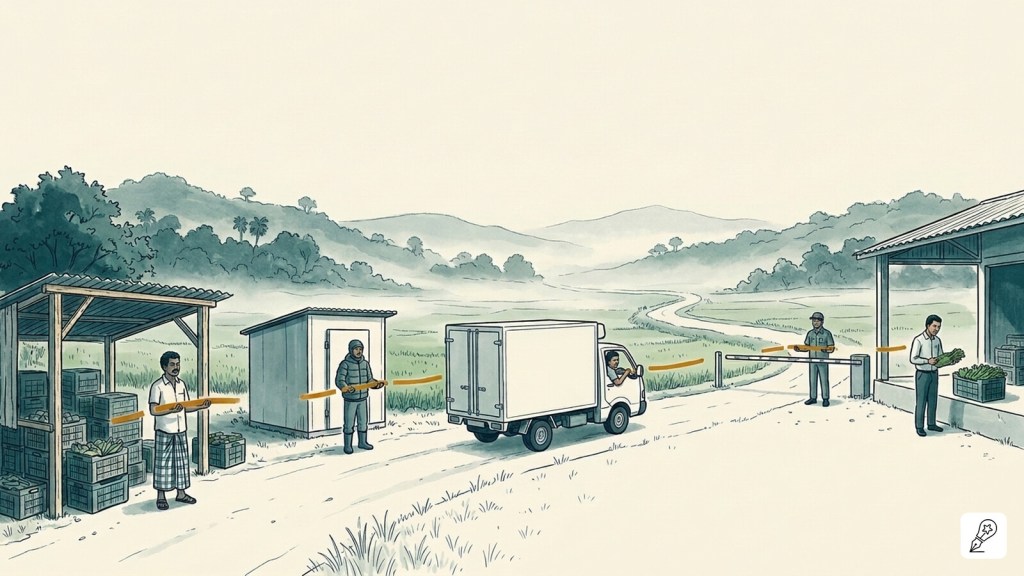
A lorry leaves a collecting centre before dawn with a load that is still cold. Between there and the buyer’s dock, four hours happen that nobody records. Part of the load is marked down at receipt, and everyone in the chain has a true explanation.
I have spent my working life integrating systems across organisations, and the hard part was never the model. It was getting the other party to send the event — on time, in a usable shape, on a Sunday.
That is this essay in one line. Useful AI requires timely operational data and cooperation across the journey of goods or passengers.
So the first question is not which optimiser to buy. It is: where is the money leaking, and who holds the number that would show you?
Where is the cost actually leaking?
Movement costs you money in five ways, and only four are losses. Goods and people wait. Vehicles run empty on the return leg, because the load going the other way belonged to somebody else. Perishables lose grade, or lose everything. A connection is missed by nine minutes, and somebody’s day is rebuilt around it.
The fifth is poor visibility, and it is not a loss in itself. It is why the other four go unmeasured. You cannot cost an empty leg you did not see, and a loss with no number gets treated as an operating condition, not a problem.
Spoilage is the one Sri Lanka can see the shape of. A 2021 open-access review by engineers at Sri Lanka’s National Engineering Research and Development Centre and the University of Peradeniya puts post-harvest losses at 20–40% for vegetables and 30–40% for fruits. It is a synthesis of existing literature rather than a measurement of its own, and the range is that wide because nobody measures the thing precisely — which is the point, not a flaw in the paper.
What that loss does to a farmer’s income is a later essay. Here it stays a logistics number: it reaches the farm gate and stops.
Choose the technique by the bottleneck, not by what is on offer
Once you can name the loss, the technique stops being a preference and becomes an inference. The mapping is my proposal, not a standard.
Forecasting, when the loss comes from not knowing what is coming.
Routing and scheduling, when the wrong asset is in the wrong place.
Condition and maintenance monitoring, when the asset fails in service.
Exception handling, when nobody notices in time — the alert that should have reached a person while there was still a decision to make.
Notice how much of that is prediction and scheduling. Keep conventional rules and workflow automation separate from statistical prediction, and both separate again from generative models and from software that acts on its own: they fail differently and need different evidence before anyone trusts them. Much of what those four lines need is not AI at all. It is a timestamp that arrives.
The investment case for any of them — where the value appears, what it costs, whether to scale — is an earlier essay in this series. I will not rebuild that worksheet here; this essay’s cost argument is a different kind of thing.
The number you need is held by someone who has no contract to give it to you
Here is the step that decides whether any of it works. Write down the data events the model needs, and beside each one write who owns it — not which system stores it. Who owns it commercially.
My proposal · illustrative. A constructed cold-chain example: no organisation, no route, no commodity, no figures.
| The event the model needs | Who holds it, and must agree to send it |
|---|---|
| Intake time and field temperature at the collecting centre | The collector |
| Pull-down temperature and set point before loading | The cold-store operator |
| Continuous temperature and door-open events in transit | The transport provider |
| Gate-in, gate-out and the actual wait at the dock | The receiving warehouse |
| Rejection or markdown at receipt, with the reason | The buyer |
Five events, five parties — and the financial consequence lands almost entirely on the last. The buyer carries the loss; the four events that would explain it sit with people who have no obligation to send anything, and in some cases an incentive for the gap to stay dark.
Sri Lanka Customs’ Time Release Study 2025 measured a version of this. In a sample of 6,787 declarations of seaport general cargo imports in 2025, less-than-container-load cargo took a median 77:54 hours to release, against 44:23 hours for full-container loads — measurements, not targets, and general cargo, not perishables. The study links that difference to cargo handling and examination processes “rather than statistical outliers”, and concludes that LCL cargo “remains structurally more time-intensive due to handling complexity and multi-party dependencies”.
Multi-party dependencies. A government study of its own seaport clearances, naming this essay’s problem in its own words.
The same study reports a median release time of 30:13 hours for consignments from traders accredited under the Authorised Economic Operator programme, against 52:50 hours for non-accredited consignments — 43% shorter, not a halving. Both are medians; the accredited group is 400 declarations against 6,387; and accredited traders are by definition already selected as low risk. The gap is real and measured. It is not proof that the sharing alone caused it.
What the customs case shows is what changes when the terms of trust between parties are written down. It does not show a private agreement doing it: an AEO status is an accreditation granted by a regulator, not a contract between operators. That one still has to be built.
So build it — an agreement between operating parties setting out who sends which event, by when, to what accuracy, at whose cost, and what follows when it does not arrive. Not a procurement contract; buying the capability is a different essay. And not one company’s platform everyone else is invited to join, which is the usual answer and the wrong one. Shared foundations can reduce duplication while leaving each owner accountable for their own outcomes.
The blocker is a contract, not an API.
“Our costs fell. Their inventory is their problem.”
Now the objection, and it is not weak. A logistics leader will say: we optimised our network, our costs fell, we measured the fall correctly, and if our suppliers now hold more inventory and our subcontractors wait longer, that is theirs to solve. That is what a competitive market is for.
Concede the true part. The saving is real, and no single firm is obliged to optimise a system it does not own.
Then read the thesis backwards. The cooperation the model needs is the same cooperation that cost-shifting destroys. A partner who learns that an honest event raises their own costs will stop sending it — late at first, then carelessly, then not at all. Your optimiser’s data decays in proportion to how well it worked for you. That is my judgment, not a finding, and it is why the agreement above must price the sharing, not assume it.
Research local conditions, and recognise that optimisation for one actor may shift costs onto another. That is not a moral footnote. It is a failure mode.
Weather, connectivity, and the arrangements that are not in any system
Three local conditions, and imported playbooks usually carry only the first two.
Weather here is not a disruption, it is a season: the road that closes every year, the humidity that changes what shelf life means.
Connectivity: design for the connection you actually have, not the one in the specification — an earlier essay in this series is entirely about that. An event that cannot be sent from where the vehicle is has not been captured at all.
Then informal operating practices, the one the playbooks leave out. The three-wheeler that always makes the connection. The arrangement between two dispatchers that is in nobody’s system. That is real operating knowledge, and your data does not hold it. Do not begin by calling it inefficiency: formalising it costs something, and sometimes it destroys the very thing that was working. That is my judgment, not a finding.
Simulation across one defined corridor supports analysis, and that is all it does: it acquires nobody’s legal authority, and it does not hold all the human circumstances that keep a corridor running.
Preserve operator judgment, and test recovery from bad predictions
Two requirements, and the second is the one that gets dropped.
The dispatcher who overrides the system is your most valuable sensor, not your compliance problem: capture the reason for every override and treat it as evidence about the model, not a reprimand. Let software act on its own only inside authority you have written down and limits you have tested — it may re-sequence within a window; it may not cancel a delivery.
Recovery from bad predictions is a testing obligation, not a caveat on a slide. Write the drill and rehearse it before go-live. The model said the load would clear by noon; at two o’clock it has not. Who is told, what are they authorised to do, what does recovery cost, and who pays? If nobody can answer that today, the system is not ready. That is my judgment, not a finding.
Pilot one corridor. Measure reliability and full cost.
Ambition should be paired with staged implementation and explicit uncertainty. In practice: one corridor, or one value chain, end to end, with every party in it — not three pilots in three business units, each optimising its own quarter.
Measure reliability, not an average alone. Sri Lanka Customs found its clearance-time data “highly positively skewed”, and complements average release time with “median-based indicators, which more accurately reflect routine clearance performance”. The tail is what your customer experiences. My rule: measure the median and the worst tenth.
Then measure full cost — every party’s, including the one that now waits longer than before. If somebody’s cost went up, you have not found a saving. You have found a transfer, and you should know which before you scale.
What it takes for that pilot to become how the work is done, and what the contract that buys the capability should say, are later essays — as is what to do with the hours a good exception-handling system hands a dispatcher back. Released capacity is not a saving until somebody decides what it is for.
So what do you do on Monday?
None of this starts with software. It starts with a meeting nobody has called yet.
Here is the diagnostic — mine to propose, not a roadmap:
- Which of the five losses is biggest in your chain, and what is the number?
- Which technique does that loss call for, regardless of what is being sold to you?
- Which data events would it need, and who owns each one?
- What would it cost that owner to send them, and who pays that?
If you can answer the first three and not the fourth, you do not have a data problem. You have a contract that nobody has written.
The question I leave you with is not a technical one. Who would you have to get into a room — and what would you offer them for the event you need?
This is the thirty-first essay in a series asking how people, organizations and nations can turn increasingly capable AI into greater human capability, better services and sustainable economic opportunity. Part VI, on sector outcomes and international learning, opens here.
Next in this series: A27 — Does Agricultural AI Help Farmers Earn More and Lose Less?
All essays in this series: AI, Human Agency and the Digital Economy
Sources
- Time Release Study 2025 — Sri Lanka Customs (PDF), conducted following the World Customs Organization’s TRS Guidelines v4.0. The LCL and FCL medians (77:54 against 44:23) and both attributions quoted above; the AEO and non-AEO medians (30:13 against 52:50); and the method note on positively skewed clearance times and median-based indicators. Scope that travels: seaport general cargo imports, calendar year 2025, a sample of 6,787 declarations drawn from transaction-level customs data. Not air cargo, not exports, not perishables or cold chain. The AEO comparison is 400 declarations against 6,387, both figures are medians, and it is an observed gap between two selected populations — accredited traders are already assessed as low risk — not a measured effect of data sharing.
- Reducing post-harvest losses in fruits and vegetables for ensuring food security — Case of Sri Lanka — Rajapaksha et al., MOJ Food Processing & Technology, 2021 (PDF). The loss ranges quoted above: 20–40% for vegetables and 30–40% for fruits. Labelled “Review Article | Open Access” — a synthesis of existing literature, not a field measurement, by authors at Sri Lanka’s National Engineering Research and Development Centre and the Faculty of Engineering, University of Peradeniya. The PDF is hosted on a University of Colombo staff page; hosting is not authorship. Its peer-review process was not verified. Its tonnage figures are cited to the Central Bank of Sri Lanka Annual Report 2018 and its monetary figures are internally inconsistent — neither is used here, and the ranges are never collapsed to a single number.


Leave a Reply