AI, Human Agency and the Digital Economy · Part 37 of 41
Somewhere right now there is a system that works.
The staff like it. It answers faster than the thing it replaced. The dashboard is green, the reports go out on time, and when somebody senior asks how it is going, everyone in the room has an answer ready. I have helped build things like that. It is a fine feeling, and it is not the end of the question.
Because nobody in that room has been asked what the system draws off the grid, who replaces the hardware when it stops being worth repairing, how much staff time it quietly occupies, or what the same money would have produced somewhere else.
And nobody has been asked the hardest one: under what condition would we stop?
Well, a project that works is not automatically a project worth keeping.
What does a working system actually cost?
I could not find a Sri Lankan source for any of the cost items below, and I do not believe one is published. What follows is international, used for the mechanism, never as a stand-in for our own numbers.
Energy first. The International Energy Agency’s 2025 report on energy and AI estimates electricity consumption from data centres globally — all data centres, not AI alone — at around 415 terawatt hours in 2024, about 1.5% of global electricity consumption. Its Base Case projects that figure roughly doubling, to around 945 TWh by 2030, just under 3% of the global total — a model output, not a measurement of anything that has happened.
And efficiency does not rescue it. Even in that report’s more efficiency-favourable High Efficiency case, improvements are “expected to offset most of the impact of increased IT stock utilisation.” Most, not all. That small word is where rebound effects live: each task gets cheaper, so we run far more tasks, and total consumption climbs anyway. The rule I hold myself to here is plain — “Account for rebound effects and avoid unsupported claims of carbon reduction.”
Where the energy goes matters too. One peer-reviewed measurement study reports roughly 51,700 kilowatt-hours to train the largest of the models its authors built themselves, another 7,600 to fine-tune it, and about a ten-thousandth of a kilowatt-hour per query — so the energy of running it only matches the energy of building it past six hundred million queries. Those are per-model figures from one research group, not a national total.
Then the equipment lifecycle, where nobody can give you a clean answer at all. The same authors write that research into the footprint of manufacturing the hardware “has been impeded by a lack of transparency from the designers of common computing hardware.” I would rather write that than a confident percentage, because the percentages in circulation are repeated rather than measured.
Operating expenditure — licences, hosting, support, the people who keep it alive — has its own essay and its own worksheet earlier in this series, and I will not redo that work here.
Which leaves the item almost nobody counts, and the one that makes this a public ledger rather than a procurement checklist: opportunity cost — not what the project costs, but what the same money, officers and attention would have produced elsewhere.
The UK Treasury’s Green Book — appraisal guidance for one government, not law, and not ours — puts it plainly under sunk costs: “practitioners should consider the opportunity costs of continuing to use resources that have already been paid for.” Notice what that does not say. Money already spent is no argument for carrying on; it is gone either way. The live question is the resource you still hold — the server you own, the officer already assigned — and whether it is doing the most useful thing available to it.
For a government, that is the whole argument. Every rupee inside a working AI project is a rupee not inside a clinic, a classroom or a road, and the project working does not settle that comparison; it only makes it worth taking seriously.
Who is not in the denominator?
Every project reports the people it reached. Almost none reports the people it cannot reach, because they are not in the data at all — they never transacted, never logged in, never appeared.
Three questions belong together: who benefits, who bears risk and who may be left out. The third is the one that gets quietly dropped, and it is the one I care about most.
We do not have to guess. Our own 2024 census counted 370,229 people aged 60 and over living alone — a count of people, never a rate. The same release reports 3,223,413 people with functional difficulties, and that count travels with its caveat in the same breath: the rate published alongside it does not reconcile with the count, and the source does not explain the gap.
Now ask what an online-only service offers someone inside that first number who has nobody in the house to set up a phone. Usually, nothing. An earlier essay was written about exactly this population, so I will not re-argue it — only insist that it belongs in a column, because “who is left out” stops being a sentiment the moment it has a number beside it. Exclusion that is counted is exclusion somebody has to answer for.
What would you actually fill in?
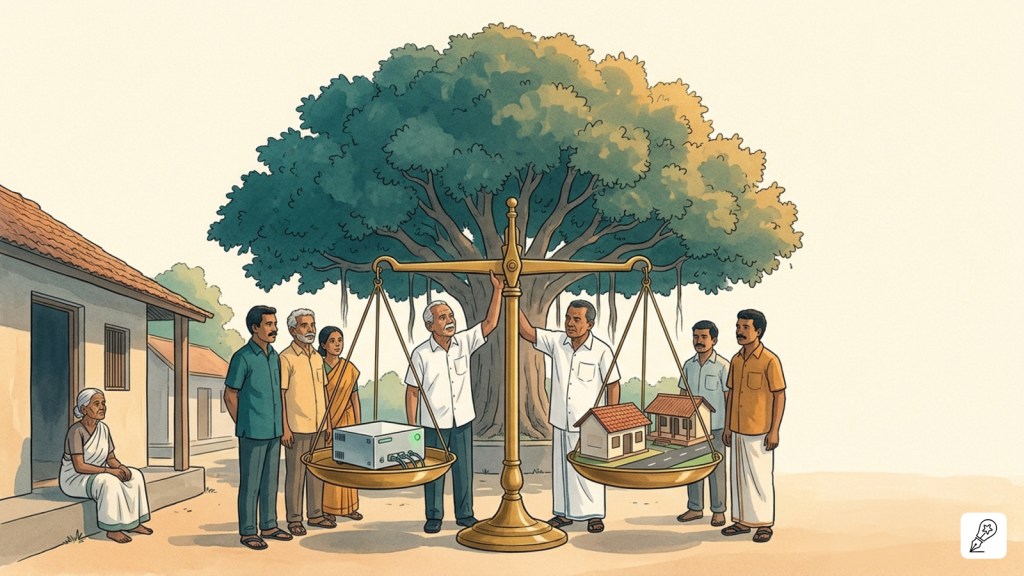
So here is the device: a project scorecard balancing development outcome, inclusion, reliability, environmental burden and affordability. Five columns, filled in before the money moves.
| Column — my proposal, unweighted and never validated | The question it forces before funding |
|---|---|
| Development outcome | Which measured change, in whose life, against what starting point |
| Inclusion | Who cannot reach this at all — named, and counted |
| Reliability | What happens to the person the system gets wrong |
| Environmental burden | Energy drawn and equipment consumed, each stated with its boundary |
| Affordability | What it costs to keep running, and what that same money would otherwise have done |
The first column takes the official indicators named in the essay before this one, whose own example is a long-running government service in which nothing in the public record shows that a decision point was ever reached.
Now let me say plainly what this is. I could find no government anywhere that has run a scorecard of this shape on an AI portfolio and published the result. No effectiveness evidence exists for it — and there is no validated AI-development scorecard in existence, mine or anyone else’s. It is my proposal, untested, and I would rather you knew that before using it than afterwards. The same goes for the reference architecture I set out earlier in this series: my proposal, never validated and never adopted.
The columns are unweighted on purpose. You will want to weight them, and you probably should — a ministry that places affordability above inclusion is making a different choice from one that does the reverse. But that is a political choice, not a technical one, and it belongs to the people who answer to the public, not to me and not to the tool.
Continue, revise, or retire?
Three outcomes, and only the third is unusual. We are comfortable with continue. We are comfortable with revise. Almost nobody writes down retire — and a decision set without it is theatre.
A trigger is a sentence written before launch: if by this date the service has not moved this measure past this line, we revise it; if it still has not by that date, we stop. Continue then becomes something earned rather than assumed, revise becomes honest instead of embarrassing, and retirement becomes a legitimate outcome instead of a scandal. This test, like the scorecard, is mine and unvalidated.
Doesn’t every project already do this?
Here is the objection. It is a fair one. Impact reports, logframes and indicator tables already sit on every development project, and none of them has ever stopped one. Why would one more scorecard behave differently?
It would not — not if it is filled in the way they are all filled in: afterwards, by the people who spent the money, to explain what happened.
What I will defend is the order of operations. A retirement trigger has to be named before launch or it is not a trigger, and it is the one item here that cannot be written retrospectively. I went looking for a project that had one and was retired anyway, and did not find a single documented case. That absence supports the argument; it does not prove the instrument works, because nobody has yet run it on a live funding decision.
What does my own work score?
Which leaves the only place this can honestly end. What I wanted you to leave with is “a practical development-impact test for the whole series’ proposals” — and the whole series has to include mine, or it is not a test, it is advertising.
So run the five columns across the architecture, the scorecard and the recommendations I have put forward. Development outcome: proposed, never measured. Inclusion: nothing I have proposed reaches the people the census counted living alone. Reliability: unknown. Environmental burden: uncounted. Affordability: unpriced.
On my own instrument, none of my own proposals qualifies for continued funding today. What they qualify for is a starting measurement, a trigger and a date — and printing that is the only thing that makes the instrument worth handing to anybody else.
This matters beyond the paperwork. Public money is always somebody’s — a teacher’s, a three-wheeler driver’s, a farmer’s — and the people who never appear in the denominator are our parents and our neighbours. The most respectful thing we can do with money that is not ours is to say out loud, in advance, what would make us stop spending it.
The line I keep coming back to is this one:
“Ambition should be paired with staged implementation and explicit uncertainty.”
So name what would make you stop, before you start. And that is the test.
This is the thirty-seventh essay in a series asking how people, organizations and nations can turn increasingly capable AI into greater human capability, better services and sustainable economic opportunity. Part VI closes here.
Next in this series: C01 — A Digital Twin Is Not a Mirror of the Country — coming next.
All essays in this series: AI, Human Agency and the Digital Economy
Sources
- Energy demand from AI — Energy and AI — International Energy Agency, 2025. The 415 TWh / ~1.5% figure for 2024, the ~945 TWh / just-under-3% figure for 2030, and the efficiency-offset sentence. Global totals for all data centres, not for AI alone; the 2030 figure is a Base Case projection, not a measurement, and the “offset most” sentence sits inside the report’s High Efficiency case.
- Power Hungry Processing: Watts Driving the Cost of AI Deployment? — Luccioni, Jernite & Strubell, ACM FAccT ’24 (arXiv v3, 15 October 2024). The training, fine-tuning and per-inference energy figures, and the hardware-manufacturing evidence-gap sentence. Per-model measurements by one research group; the parity point is against training plus fine-tuning combined.
- The Green Book (2026) — HM Treasury, updated 5 February 2026. The opportunity-cost clause under “Sunk costs”. UK appraisal guidance, quoted for one clause; guidance, not law, and not Sri Lankan.
- Census of Population and Housing 2024 — press note — Department of Census and Statistics, 10 April 2026. The 370,229 and 3,223,413 figures. Counts only, never rates; the published rate accompanying the functional-difficulties count does not reconcile with it and the source does not explain the gap.


Leave a Reply