AI, Human Agency and the Digital Economy · Part 1 of 41
I am the founder and CEO of Idasara Digital and a daily user of these tools across several models and several production projects. This is what a year and more of volunteer AI workshops with Sri Lankan public officers, most recently in collaboration with the Presidential Secretariat of Sri Lanka and the Ministry of Justice’s Language Unit, is teaching me about language, connectivity and institutional readiness.
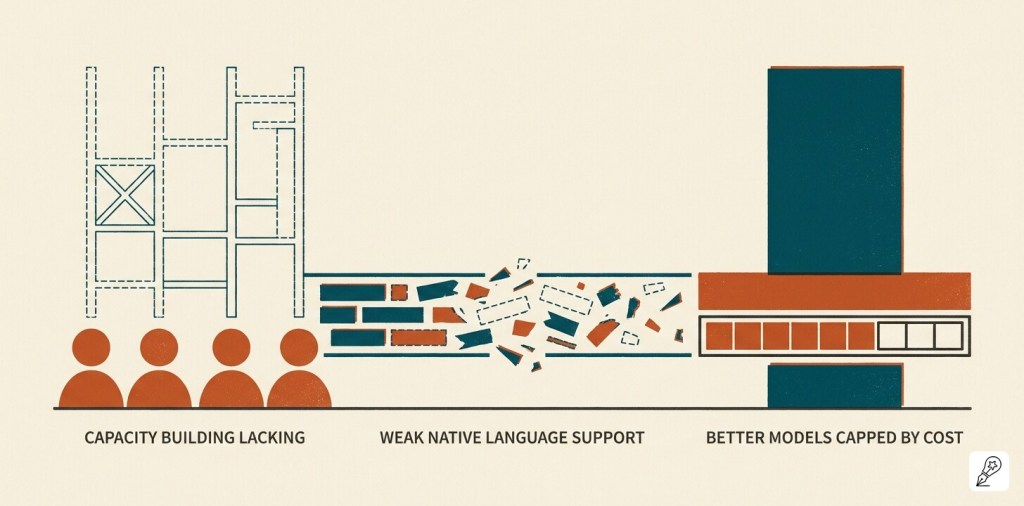
In training halls across Sri Lanka, public officers are not waiting for permission — they are already at work with generative AI, driven by initiative from below while the institutional scaffolding of structured capacity building remains completely unbuilt above them. Yet the moment they attempt to translate that energy into real public service, they slam into two unyielding walls: the models degrade and fracture when tasked with complex reasoning in Sinhala and Tamil, and the frontier systems that might solve those problems remain locked behind prohibitive token cost ceilings that public budgets cannot carry. The image captures this reality in three austere geometric stages: motivated people laboring under an empty scaffold, a broken channel where local language reasoning shatters, and a distant monolith of advanced intelligence barricaded behind a meter they cannot feed.
Most of what I now think about AI in Sri Lanka, I did not work out at a desk. I worked it out in three-hour workshops with public officers, in places I had to travel to reach.
Why do I keep doing it? Honestly, because I like it: the travel, the people, work that is contributed rather than invoiced. What I did not expect was how much the rooms would teach me.
The workshops are volunteer work — three hours, no fee — run in collaboration with the Language Unit of the Ministry of Justice. It is a collaboration and nothing more: it does not mean the Ministry endorses my architecture, my articles or my products. These essays are mine alone. So far the series has taken me to the Ministry of Justice office in Colombo, and to Hambantota, Kurunegala, Anuradhapura and Jaffna. Across my broader volunteer training work, more than ten thousand public officers have attended sessions I have taught — attendance, across more than one programme and more than a year.
Nobody needs me to introduce AI
If I ask a group of public officers who is already using AI tools, many in the room already are. They did not wait for a policy, a circular or a trainer: they found the tools, opened them, and worked out what to type. There is nothing there to introduce.
That changes the job. If awareness had been the gap, a workshop would have been the answer. Awareness is not the gap. So what I add is depth and design: how to say precisely what you want, how to judge whether the answer is any good, how to think about a whole service rather than a single task, and how to keep your judgement in the loop. I should say where I am standing when I say that. I do not comment on this technology from the outside; I use it every working day. My own transcripts from the last month record close to six hundred prompts — around two hundred a week — across several models and several live projects: building agents that run in production, and writing at length with them. One prompt in that month was a correction I had to walk back. None of this makes me right. It does mean the depth I try to teach is not something I read about. It is what I had to learn at volume, on work that had to ship, mostly by getting it wrong first.
It is not only our pattern. In OECD member public administrations — not here — surveys indicate that a significant proportion of public servants already use open-access generative AI tools, and most public-sector institutions lack a structured approach to identifying the AI skills they need. Initiative from below, no structure above it.
Three walls that have nothing to do with motivation
The officers I meet are not short of motivation. What stops them is the environment. Three walls come up again and again.
Language. In the sessions I teach, officers run into the same wall: when the work has to come out in Sinhala or in Tamil, the output needs more checking than the English does. That is what I have seen in workshops, not a benchmark I have run.
Researchers are finding the same shape. A study accepted to ITHET 2026 (preprint on arXiv) set school mathematics problems written independently in Sinhala, Tamil and English, not translated. Basic arithmetic reasoning travelled between the languages. Complex reasoning degraded significantly in Tamil and Sinhala. Their own words are the ones worth pinning up in every procurement office: the pattern of failures varies by model and problem type, “suggesting that strong performance in English does not guarantee reliable performance across languages.” School mathematics is not legal Sinhala, and their conclusion is modest — evaluate each language before you adopt. A separate Sinhala-only benchmark points the same way: overall model performance remains limited.
This is not a niche preference. Under Chapter IV of our Constitution, Sinhala is the Official Language, Tamil is also an official language, and English is the link language. Constitutional status is not delivery. But it does mean that a tool working well in English and unevenly in Sinhala and Tamil is not “nearly there” for public service. It does not yet work for the service. Nor is the point new: Sri Lanka’s Digital Economy Blueprint, published on ICTA’s website and undated on the document (PDF created 2 December 2025), already names “large language models (LLMs) in native languages” among the technologies expected to drive the next wave of productivity and service innovation.
And this series is in English, about a problem that is mostly about Sinhala and Tamil. The reader it is most about may not read it comfortably. I would rather say that than pretend the choice was neutral.
Connection. The regulator’s provisional December 2025 figures record 21,991,606 mobile broadband subscriptions — a density of 100.79, more than 100 subscriptions for every 100 people. Subscriptions are not people, and the regulator publishes no coverage or quality-of-service data at all. Separately: I have run sessions where the connection would not hold long enough to finish a demonstration. A national density cannot tell you whether the work can be done in one room on one morning.
Hosting. This is the one that bothers me most. Officers build something useful in three hours, and then have nowhere supported to run it. I am describing what I have seen in workshops, not a diagnosis of why: access, budget, approval, operational support, or all four — I have not investigated it.
What this is evidence of, and what it is not
Let me put the strongest objection on the table myself: workshop participants are not a representative national sample. The officers in my rooms are the officers who were in the room; I do not know how they compare with everyone who was not. More than 1.1 million people work in Sri Lanka’s public and semi-government sector, on the Department of Census and Statistics’ preliminary 2024 count. Ten thousand attendances is a small fraction of that.
The deeper objection is the one I agree with most: enthusiasm is not readiness. A room of keen, quick, already-experimenting officers tells you the appetite exists, not whether their institutions can absorb what they build. Confusing the two is how a country ends up with a trained workforce and unchanged services.
From a clever prompt to a service that works
The natural next step for a motivated officer is a better prompt. It is also a ceiling.
A prompt improves one person’s task. A citizen never experiences a task; they experience the whole service — the form, the record, the approval, the exception, and what happens when it goes wrong. So the second half of the workshop moves from prompting toward design: what is the citizen trying to get done, who checks the output before it reaches the public, what happens on the bad day?
The OECD, on evidence from its member administrations, puts it more crisply than I do: “Rather than automating existing processes, AI can be part of a redesign towards integrated, citizen-centred public services.” That is the shift I try to teach: human language knowledge, citizen-centred design, and systems that work in all three languages — with generated content used under judgement, not in place of it.
It is also why, in the AI-First Agentic Digital Economy Reference Architecture I have proposed, citizen-centricity and human capability run down the side of the whole diagram instead of arriving as a final phase, with hosting and connectivity underneath. That is my proposal, not a validated or adopted standard.
If you want the teaching material rather than my reflections, it is open to read. Everything I cover in these sessions is written up in the AI for the Public Sector track at Idasara Academy — the material I wrote and present in the workshops. There is also an AI for Everyone track on the same hub, for readers who are not in the public service but want the same grounding.
Does the training have anywhere to land?
Here is the question I have started asking on the way home. Not “did the session go well?” — sessions usually do. It is whether any of it will exist in three weeks.
Workforce-development research, largely from the United States, has a name for what decides that: transfer climate. Whether training becomes practice depends largely on three things: the trainee, the design of the training, and the work environment — supervisor, peer and organisational support, plus coaching and feedback afterwards (a US workforce-development centre’s synthesis of three meta-analyses: Blume et al., 2010; Hughes et al., 2020; Reinhold et al., 2018). The OECD reaches the same place from the institutional side, in those same member administrations: the longer-term effectiveness of training “may be supported by a conducive environment for learning and innovation.”
Both say carefully what I now believe plainly: a trainer can deliver capability, not readiness. Readiness is delivered by the institution, or not at all.
Four questions to ask about your own office tomorrow
This is the part I would most like a department head to use.
- Tools. Which AI tool is the officer who attended the training allowed to open tomorrow morning, on which device — and who pays for it?
- Access. When the connection drops in that office, does the work stop, or does the process still function? Ask about the worst day.
- Permission. Is there a written rule the officer can point to about what may and may not go into an AI tool? If the answer is “use your judgement”, the officer is carrying your risk.
- Support. Who does that officer ask when it breaks in three weeks, after the trainer has gone home?
And one I cannot answer for anyone: where does the thing that officer built run on Monday?
If those answers are thin, your people do not need more training. The training you paid for has nowhere to land.
Capability, opportunity, responsibility
I have written before that the purpose of this technology is to widen what a person can do and decide — agency, in one word. Capability without permission is frustration. Permission without tools is a memo. Tools without support are a pilot that quietly dies.
And those three do not grow at the same rate. In the rooms I teach, capability is growing fastest, inside the officers themselves. Opportunity — the tool, the connection, the place to run the thing — lags behind. Responsibility, meaning who answers when an AI-assisted decision reaches a citizen and is wrong, lags behind both. Every hard question in the essays to come lives in one of those gaps.
So take one office, ask the four questions, and see whether you like the answers. If you do not, you have found something more useful than a training budget: you have found the actual constraint.
This series begins there, with one question. How can people, organizations and nations turn increasingly capable AI into greater human capability, better services and sustainable economic opportunity?
Next in this series: A02 — What Should a National AI Strategy Be?
All essays in this series: AI, Human Agency and the Digital Economy
At a glance
- I teach volunteer, unpaid, three-hour AI workshops for Sri Lankan public officers.
- Sessions have run in Colombo, Hambantota, Kurunegala, Anuradhapura and Jaffna.
- More than 10,000 public officers have attended sessions I have taught, across my broader volunteer training work.
- In my workshops, Sinhala and Tamil AI output needs more checking than English output does.
- In some of my sessions, the connection has not held long enough to finish a demonstration.
Questions people ask
What have I learned from teaching AI workshops to Sri Lankan public officers? Most officers attending my volunteer AI workshops already use AI tools on their own — awareness is not the gap. What is missing is an enabling environment: language support, reliable connectivity, and somewhere to host what officers build.
Why does AI output in Sinhala and Tamil need more checking than in English? In the workshops I teach, officers report that AI output in Sinhala or Tamil needs more checking than English output. Separate academic research on Sinhala and Tamil maths problems reaches a similar conclusion: strong English performance does not guarantee reliable performance in another language.
How many public officers have attended my sessions? Across my broader volunteer training work, more than 10,000 public officers have attended sessions I have taught, over more than one programme and more than a year. The figure is not attributed to any single series, and does not measure proficiency gained or services improved.
What four questions should a department head ask before scaling up AI training? I recommend asking: which AI tool can the officer use tomorrow and who pays for it; does the work still function when the connection drops; is there a written rule on what may go into an AI tool; and who supports the officer after the trainer leaves.
Sources
- Constitution of the Democratic Socialist Republic of Sri Lanka — Chapter IV, Language (Articles 18–19) — Parliament of Sri Lanka (PDF).
- Telecom Statistics of Sri Lanka, January 2026 — Telecommunications Regulatory Commission of Sri Lanka (PDF; December 2025 density figures marked provisional).
- Census of Public and Semi Government Sector Employment 2024 — Preliminary Report — Department of Census and Statistics, April 2025 (PDF; census conducted 28 May 2024).
- Large Language Models for Math Education in Low-Resource Languages: A Study in Sinhala and Tamil — Kishanthan, Thushalika, Jayasekara & Hevapathige, 16 February 2026 (accepted to ITHET 2026).
- SinhalaMMLU: A Comprehensive Benchmark for Evaluating Multitask Language Understanding in Sinhala — Pramodya et al., 3 September 2025 (preprint; Sinhala only).
- Sri Lanka’s Digital Economy Blueprint — published on the ICTA website; undated on the document (PDF created 2 December 2025).
- Building an AI-ready public workforce: Implications and strategies — OECD, 19 January 2026 (evidence from OECD member public administrations).
- Training Transfer — umbrella summary — Quality Improvement Center for Workforce Development, 30 November 2022 (synthesising Blume et al. 2010; Hughes et al. 2020; Reinhold et al. 2018; the underlying meta-analyses are paywalled and were not read).
First published on Medium on 27 September 2026.


Leave a Reply