
AI, Human Agency and the Digital Economy · Part 5 of 41
Writing against a Right to Information Act that has required Sri Lankan public authorities to proactively disclose since 2017, I argue that a public conversation about AI counts only when the problems people raise change what gets designed, funded and reviewed, and I set out a five-stage plan naming who must publish what, and when.
Being heard is easy to arrange. A hall, an invitation, a morning of honest listening, and by lunchtime everyone in the room has been heard.
Something changing is a different matter, and the only thing worth asking people to travel for.
The question is not whether Sri Lanka is having a conversation about AI. It is narrower. Engagement becomes meaningful when the problems people raise affect design, investment and accountability. Short of that, we have run a good morning.
Four different things we keep calling one thing
Awareness, consultation, co-design and adoption support are four different activities, and in my experience the invitation rarely says which one is on offer.
The International Association for Public Participation — a practitioners’ federation, not a lawmaker — publishes a spectrum where each level is defined by what the convener promises. At Consult, the promise is to “provide feedback on how public input influenced the decision.”
Read that way, consultation is not a meeting. It is a debt.
The fourth mode is mine, because that ladder stops at the decision and says nothing about the person who has to use what gets built.
I should say where my own work sits on this ladder. What I run is awareness — with real episodes of co-design inside the room, when a group stops reasoning from the old process and asks what could be done newly — and it is not consultation: nothing raised in one of my sessions has travelled through to a funded experiment with a published result.
Can the people it is about reach the room?
Three languages is a legal baseline here, not a kindness: under Chapter IV of the Constitution, Sinhala is the official language, Tamil also an official language, English the link language.
Then the channel. The Department of Census and Statistics’ 2024 computer-literacy bulletin — figures the department itself asks be read with caution, because the coefficients of variation are high — puts internet use in the past year, among people aged 5 to 69, at 54.6% nationally, 37.7% in the estate sector and 17.8% among people aged 60 to 69, and digital literacy, meaning the use of a computer, tablet or smartphone unaided, at 65.0% nationally against 44.6% in the estate sector.
Those figures say who can reach a channel, not who wants to speak. A channel nobody can reach settles the question before anyone is asked: an online-only form in one language decides who is in the conversation, at the design stage. Radio, television and the counter at a Divisional Secretariat are channels too.
Collect problems, not opinions
A conversation that collects opinions about AI is a wasted morning. Collect problems instead, from three sides: the citizen at the counter, the officer behind it, and the small business that depends on both.
The move I would put at the centre: ask the officer which services people actually come in for, then ask that officer to look at one of those services as a citizen would — a citizen on their own income.
Record it verbatim, by role rather than by name, and publish the raw list before anyone tidies it into themes. Tidying is where the problems that embarrass somebody quietly disappear.
Experiments that are allowed to fail
Consultation asks for comment on something already drafted. Co-design begins before the drawing exists. Otherwise you will digitise the queue and call it transformation.
A few of those problems then get funded as experiments genuinely allowed to fail. In the United Kingdom’s government service manual, a discovery may end in a decision not to build: “It’s not a failure to stop at the end of the discovery phase if your research shows that’s the best thing to do.”
In Singapore, the government agency Open Government Products publishes report cards covering cost, impact and a category called “Retired — what we’ve discontinued” — its own account of its practice, not an independent evaluation. How such examples travel is a later essay.
What the law already requires
Sri Lanka already has the floor, and it is in law rather than in anyone’s plan. Under the Right to Information Act, No. 12 of 2016 — in force for public authorities since 2017 — every Minister must publish a disclosure report twice a year “in the official languages and… in electronic form” (section 8), and must tell the public, three months before a project starts, what it is, wherever the project’s value exceeds five hundred thousand rupees locally or one hundred thousand US dollars in foreign funding (section 9); every public authority must report annually to the Right to Information Commission and publish that report on its own website (section 10). None of it was written for AI, and none of it asks anyone to say what changed because of what they heard. What I am proposing starts where that duty stops.
Is it kept? The Commission’s own verdict is that compliance has been “extremely poor… since the Act was operationalized in 2017”, and it publishes no compliance rate, so nobody — including me — can put a number on it. The IMF’s September 2023 governance diagnostic, which assessed the right-to-information regime and not AI or consultation practice, is gentler: it warns that proposed bills carry “a significant risk that this outstanding example of transparency is stripped of its effectiveness”, and says separately that “implementation of these principles remains uneven.”
What no statute requires is the hardest part. The OECD’s guidelines for citizen participation processes, written for its members, put it in the step on using citizen input and providing feedback: use the inputs as promised, “with clear justifications and arguments if certain results are not used or implemented.”
That last clause is the rare one. The United Kingdom’s science and technology department published a summary of 800 responses to a digital inclusion call for evidence in July 2025: analysis, next steps, and no section saying what will not be done.
Keep the channel open after it is switched on
Deployment is where adoption support begins: a complaints route that reaches a human, feedback somebody reads, results published on a schedule. Sri Lanka’s National Evaluation Policy, published by the Department of Project Management and Monitoring — policy rather than statute, and undated — already says that “joint and participatory approaches in evidence-based evaluation will be promoted.”
The objection I cannot argue away
Participation costs money and time that the people most affected have least of.
Ghazala Mansuri and Vijayendra Rao’s World Bank review of almost 500 studies of participatory development and decentralisation — not of AI consultation, and with no Sri Lanka-specific finding in it — reports that “participants in civic activities tend to be wealthier, more educated, of higher social status (by caste and ethnicity), male, and more politically connected than nonparticipants,” which the review says may partly reflect the higher opportunity cost of participation for the poor.
And then the finding that points straight at me, on evidence the review itself calls scant: “facilitators strongly influence the stated preferences of community members, who often tell facilitators what they think they want to hear.” A room that agrees with the person at the front is not evidence. Often it is politeness.
Fixing representation is a budget line, not an intention. The OECD’s guidance lists what inclusion costs — transport, childcare, food, digital tools, accessible premises, interpretation — and calls the most representative recruitment method, the civic lottery, “lengthy and expensive”. Keeping it cheap for the participant moves the cost to the convener. So: fund it, or narrow it.
The sharpest version I accept outright: a consultation that changes nothing is worse than none, because it spends trust it cannot give back. In the European Union’s audit of its own Commission’s consultations — judged “satisfactory overall”, with outreach activities that “need improvement” — the reports telling people what had been heard appeared on average nine months after the consultation closed, 19 of 23 in English only.
Who never hears that a room exists at all is a bigger question than this essay can hold; the series goes there later.
An engagement plan that assigns ownership
What follows is a proposal. No district has run it, no office has adopted it: a design, not a report.
| Stage | Who owns it | What is published | When | If nothing changes |
|---|---|---|---|---|
| 1. Name the mode before inviting anyone | The convener who calls the meeting | The mode, its promise, and the date the account will appear, in all three languages | On the invitation | The invitation does not go out; a meeting promising nothing owes nothing |
| 2. Collect problems from three sides — citizen, officer, small business | The convener; recorded by role, not by name | The raw list, unedited | Two weeks after the session | Published anyway, marked received and not acted on |
| 3. Fund a few as experiments allowed to fail | The office whose budget carries it | What was selected, what was not and why, the budget, the stopping condition | At selection | A note that nothing was selected, and why |
| 4. Review in public, by someone who did not build it | A reviewer independent of the delivery team | The verdict — worked, or did not — and the evidence | End of the agreed window | “Did not work” is published on the day a success would have been |
| 5. Keep the channel open after deployment | The same office, still named | What was heard, what changed, and what could not be addressed | The date promised at stage 1 | Silence is the failure, not the bad result; the account appears on time |
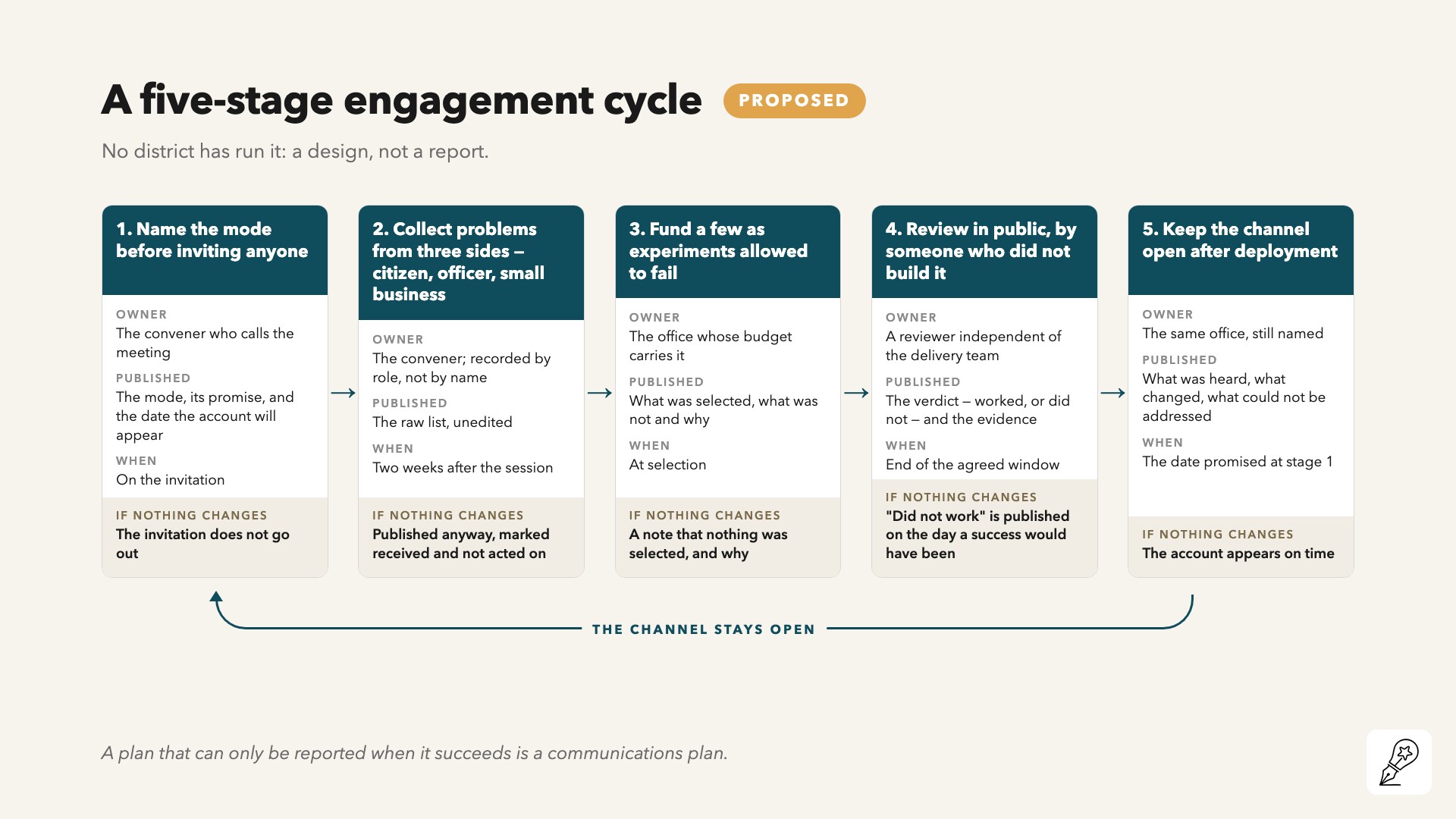
The last column is the one doing the work: a plan that can only be reported when it succeeds is a communications plan.
So take one consultation in your calendar and fill in the five columns. If you cannot name who owns stage five, what you have scheduled is awareness — a good thing to hold, as long as you call it that and nobody leaves believing they were consulted.
The learning material is free to read: the natural language revolution and the human role, a foundation module at Idasara Academy.
This series asks one question: how can people, organizations and nations turn increasingly capable AI into greater human capability, better services and sustainable economic opportunity? A conversation answers it only where what gets built changes.
Well — for the next meeting you call, what is the date on which you will publish what you could not do?
Fifth of thirty-two essays on AI, human agency and the digital economy; the next one goes to language.
Next in this series: A06 — Why Human Language Knowledge Matters More in the AI Era.
All essays in this series: AI, Human Agency and the Digital Economy
At a glance
- The thesis: engagement becomes meaningful only when the problems people raise affect design, investment and accountability — short of that, “we have run a good morning.”
- Four different activities get called by one name: awareness, consultation and co-design come from a practitioners’ spectrum (the International Association for Public Participation, 2018); adoption support — what happens after deployment — is my own fourth addition to that ladder.
- Sri Lanka’s Right to Information Act, No. 12 of 2016, already requires proactive disclosure: a biannual report “in the official languages and… in electronic form” (section 8), three months’ notice before projects above five hundred thousand rupees or a hundred thousand US dollars in foreign funding (section 9), and an annual compliance report every public authority must publish on its own website (section 10) — subject-neutral duties that do not name AI, with compliance the regulator itself calls “extremely poor” and no compliance rate published anywhere.
- A World Bank review of almost 500 studies of participatory development and decentralisation (Mansuri and Rao, 2013) found civic participants skew “wealthier, more educated, of higher social status… male, and more politically connected than nonparticipants” — a developing-country finding about community-driven development generally, not about AI consultation, and with no Sri Lanka-specific finding in it.
- My proposed five-stage engagement cycle assigns an owner, a publication date and a stated consequence for every stage — from naming the mode before inviting anyone through to keeping the channel open after deployment — offered as a design no district or office has yet run, not a report of results.
Questions people ask
What is the difference between consultation and co-design? Consultation, in the International Association for Public Participation’s spectrum, promises only to “provide feedback on how public input influenced the decision” on something already drafted. Co-design, as I frame it, begins before the drawing exists — the real episodes I have seen happen “when a group stops reasoning from the old process and asks what could be done newly.” Awareness and adoption support are two further, separate activities in my four-part scheme, and in my experience the invitation to attend a session rarely says which one is actually on offer.
Does Sri Lanka’s RTI Act require publishing what a public body heard? Not quite, and the distinction matters. Under the Right to Information Act, No. 12 of 2016, every Minister must publish a disclosure report twice a year “in the official languages and… in electronic form” (section 8), give three months’ notice before a project above five hundred thousand rupees or a hundred thousand US dollars in foreign funding starts (section 9), and every public authority must report annually to the Right to Information Commission and publish that report on its own website (section 10). None of these subject-neutral duties asks anyone to say what changed because of what they heard — and the Commission’s own published verdict is that compliance has been “extremely poor… since the Act was operationalized in 2017,” with no compliance rate ever published, by the regulator or anyone else.
Who actually turns up to public consultations? Not a representative sample, according to the evidence I cite: a World Bank review of almost 500 studies of participatory development and decentralisation found that civic participants “tend to be wealthier, more educated, of higher social status… male, and more politically connected than nonparticipants,” which the review says may partly reflect the higher opportunity cost of participation for the poor. The same review found — on evidence it itself calls scant — that facilitators strongly influence what participants say, so a room that agrees with the person at the front is not evidence of consensus — often, as I put it, “it is politeness.” The finding covers participatory development and decentralisation studies generally, not AI consultation specifically, and includes no Sri-Lanka-specific data.
How do you make an AI workshop change what gets built? By naming, in advance, who owns each stage and what they must publish. My proposed five-stage engagement cycle runs from naming the mode before inviting anyone, through collecting problems from citizens, officers and small businesses, funding a few as experiments allowed to fail, an independent public review, and keeping the channel open after deployment — with every stage stating what gets published if nothing changes. A plan that can only be reported when it succeeds is a communications plan. No district or office has run this cycle; I offer it as a design, not a report of results.
Sources
- IAP2 Spectrum of Public Participation — International Association for Public Participation, © IAP2 International Federation 2018 (PDF). Each level of participation, and the promise the convener makes at it. A practitioner federation’s framework; not law, and not evidence that anyone honours it.
- OECD Guidelines for Citizen Participation Processes — OECD, September 2022 (PDF). The step on using citizen input and providing feedback; what inclusive participation costs; the civic lottery as “lengthy and expensive”. Guidance written for OECD members; Sri Lanka is not one.
- European Court of Auditors — Special Report 14/2019, “Have your say!” — adopted 16 July 2019 (PDF). Synopsis reports published on average nine months after consultations closed; 19 of 23 in English only. The audit’s overall verdict was that performance was “satisfactory overall”, with a framework “of a high standard” and outreach activities that “need improvement”.
- Right to Information Act, No. 12 of 2016 (Sri Lanka) — official text hosted by the RTI Commission (PDF). Section 8 biannual disclosure reports in the official languages and in electronic form; section 9 three months’ notice of projects above LKR 500,000 or USD 100,000; section 10 annual compliance reports published on the authority’s own website. A subject-neutral statute; it does not mention AI.
- RTI Commission of Sri Lanka — Recent Notable Developments in regard to Sri Lanka’s RTI Act, 2024–2025 — (PDF). Compliance with sections 8–10 characterised as “extremely poor… since the Act was operationalized in 2017”. The regulator’s own published characterisation; no compliance rate is published anywhere.
- IMF — Sri Lanka: Governance Diagnostic Assessment, September 2023 — published on treasury.gov.lk (PDF). Paragraphs 96 and 97: the risk that “this outstanding example of transparency is stripped of its effectiveness”, and that “implementation of these principles remains uneven”. An assessment of the right-to-information regime, not of AI or of consultation practice.
- Department of Census and Statistics — Computer Literacy Statistics 2024, Annual Bulletin — survey January–December 2024, 25,750 households, ages 5–69 (PDF). Internet use and digital literacy by sector and by age. The bulletin prints: “These figures are to be treated with caution as the corresponding CV values are high.” Literacy here is self-assessed capability, and “digital literate” means able to use a smartphone unaided.
- Constitution of the Democratic Socialist Republic of Sri Lanka — Chapter IV, Language — Articles 18–19 (PDF). Sinhala the official language, Tamil also an official language, English the link language.
- National Evaluation Policy of Sri Lanka — Department of Project Management and Monitoring, published on treasury.gov.lk (PDF). “Joint and participatory approaches in evidence-based evaluation will be promoted.” Undated on the document; policy, not statute.
- UK Government Digital Service — Service Manual: how the discovery phase works — page last updated 21 June 2021. “It’s not a failure to stop at the end of the discovery phase…” UK central-government guidance, cited as a mechanism, not as a model.
- Open Government Products (Singapore) — product report cards — product cost, impact, and the “Retired — what we’ve discontinued” category. The agency’s self-description; no independent evaluation of it is cited here.
- UK Department for Science, Innovation and Technology — Digital Inclusion Action Plan: summary of responses — published 17 July 2025; 800 responses. The observation is about the published document’s structure, which any reader can check, not about the department’s intent.
- Ghazala Mansuri & Vijayendra Rao — Localizing Development: Does Participation Work? — World Bank Policy Research Report, 2013 (PDF); the passages quoted are at pp. 5 and 10. A review of community-driven development and decentralisation, not of AI consultation; it contains no Sri Lanka-specific finding.
- Idasara Academy — CM-03: The Natural Language Revolution, the Humanities Renaissance, and AI Literacy — my open learning material, in English, Sinhala and Tamil. A place to learn, not evidence for any claim in this piece.


Leave a Reply