
AI, Human Agency and the Digital Economy · Part 6 of 41
Why I think articulation, interpretation and official terminology are the skills that let people direct AI and catch the meaning it loses between Sinhala, Tamil and English.
Suppose a page of Sinhala arrives on your screen for approval. It reads well, the tone is right, nothing snags. You sign it.
How did you know it said the same thing as the English?
Reading well and saying the same thing are two different properties, and we treat the first as evidence of the second. Now that anyone can produce a fluent page in a language they cannot check, that habit is expensive.
My argument in one line: articulation, interpretation and terminology help people direct AI and detect meaning lost in generated material. Not soft skills any more — operating skills, and their value is going up.
I teach a three-hour AI workshop for public officers as volunteer work, and the current series runs in collaboration with the Language Unit of the Ministry of Justice — a collaboration, not an endorsement.
Natural language opened the door, and widened the room for misunderstanding
The interface to the most capable software in the world is now a sentence in your own words. No syntax, no manual, no gatekeeper. That is real democratisation, and I am glad of it.
But human language is ambiguous by design, and the machine has little of the context we use to resolve it. In 2023 linguists built a set of ambiguous sentences with their own disambiguations, and crowdworkers judged the machine’s readings against them. Even with a leading general-purpose model of the day, the machine’s were judged correct 32 per cent of the time; the linguists’, 90 per cent.
What strikes me is not the score. It is the silence: the model picks a reading and never says it picked one.
Saying what you mean is not a trick. It is thinking.
In my sessions, the officers who get consistently good results are not using secret words. They know their subject, they state the constraint, they notice what is missing, and they go round again. That is reasoning made visible: if you cannot say what “complete” looks like, no model can infer it.
Having said that, the evidence is not all on my side. Journalists put through prompt-engineering training came out feeling more expert, with no straightforward gain in accuracy. But that study measured short writing after a course, not professionals catching meaning loss in text that carries consequences — which is the capability I am arguing for. The teaching version of my argument is free: Articulation, Curiosity, and the Art of Prompting.
“But models are fluent enough now. Isn’t this solved?”
Part of this objection is right: for routine, high-frequency text the machine is fine. But fluency and correctness were never the same measurement. The machine-translation evaluation methods published in 1994 scored them separately: adequacy asked how much of the source information survived; fluency asked only whether the output read like good English, “without reference to the ‘correct’ translation, and thus without knowing the accuracy of the content.”
That separation is thirty-two years old. Fluency was graded by people not allowed to see whether the content was true — the position of an officer approving a page they can read but cannot check.
Here is an example I constructed myself — purely illustrative, from no real notice:
English source: Applications will not be accepted after 4.00 p.m. on 15 January.
The other-language edition, translated back into English: Applications will be accepted after 4.00 p.m. on 15 January.
One small word goes missing and the notice says the opposite. Fluent, polite, confidently formatted — and a citizen who obeys it arrives too late.
A dropped negation is one of the documented critical-error classes in the guidelines professional translators were given for judging machine translation, alongside shifted dates, times and numbers. An over-formal rendering is not on that list: the same guidelines say explicitly that formality does not change meaning in a critical way. A style complaint is not a meaning error, and I will not treat one as the other.
You will notice I printed no Sinhala or Tamil script above. That was deliberate: an example like this, written in either language, needs a qualified reviewer to check it before anybody publishes it. Including me.
Which Sinhala? Whose Tamil? And whose terminology?
Neither of our languages is one thing. There is the Sinhala people speak and the Sinhala that gets written down; a Tamil of the home and a Tamil of the gazette. Officers move between them all day. And terminology is not a matter of taste: for a notice, there is usually an approved word already published.
The machines do not serve either of our languages well, and the honest way to report them is separately. A Sinhala benchmark of over 7,000 national-curriculum questions found overall model performance limited, and that models struggle in culturally rich domains such as the Humanities. A Tamil benchmark of 820 Sri Lankan school examination questions found performance declining as linguistic complexity rose, its authors suggesting that performance “may be driven by exposure rather than genuine understanding.” Both are school-domain studies, and nobody, as far as I can find, has benchmarked either language on government notices at all.
Here is something the benchmarks have not measured, so take it as my impression from the room and not a finding: the squeeze is tighter for Sinhala than for Tamil. Tamil has a body of writing behind it, including from India; Sinhala has a limited range to draw on.
None of this is a user-experience preference. Under Chapter IV of our Constitution, Sinhala is the Official Language of Sri Lanka, Tamil shall also be an official language, and English is the link language. And in the chapter on fundamental rights, Article 12(2) forbids discrimination on the ground of language.
AI fluency does not erase structural language inequalities or the need for accessibility.
What a trilingual workflow actually needs
Four things carry most of the weight. One authoritative source document from which every language edition derives, rather than three kept in parallel and hoped into agreement. Official terminology, so the same office is called the same thing on every page: the Department of Official Languages publishes 88 subject glossaries, including Law and Public Administration, so the approved wording is usually already published. A review by someone who reads the target language and knows the subject. And a named human who signs the final page.
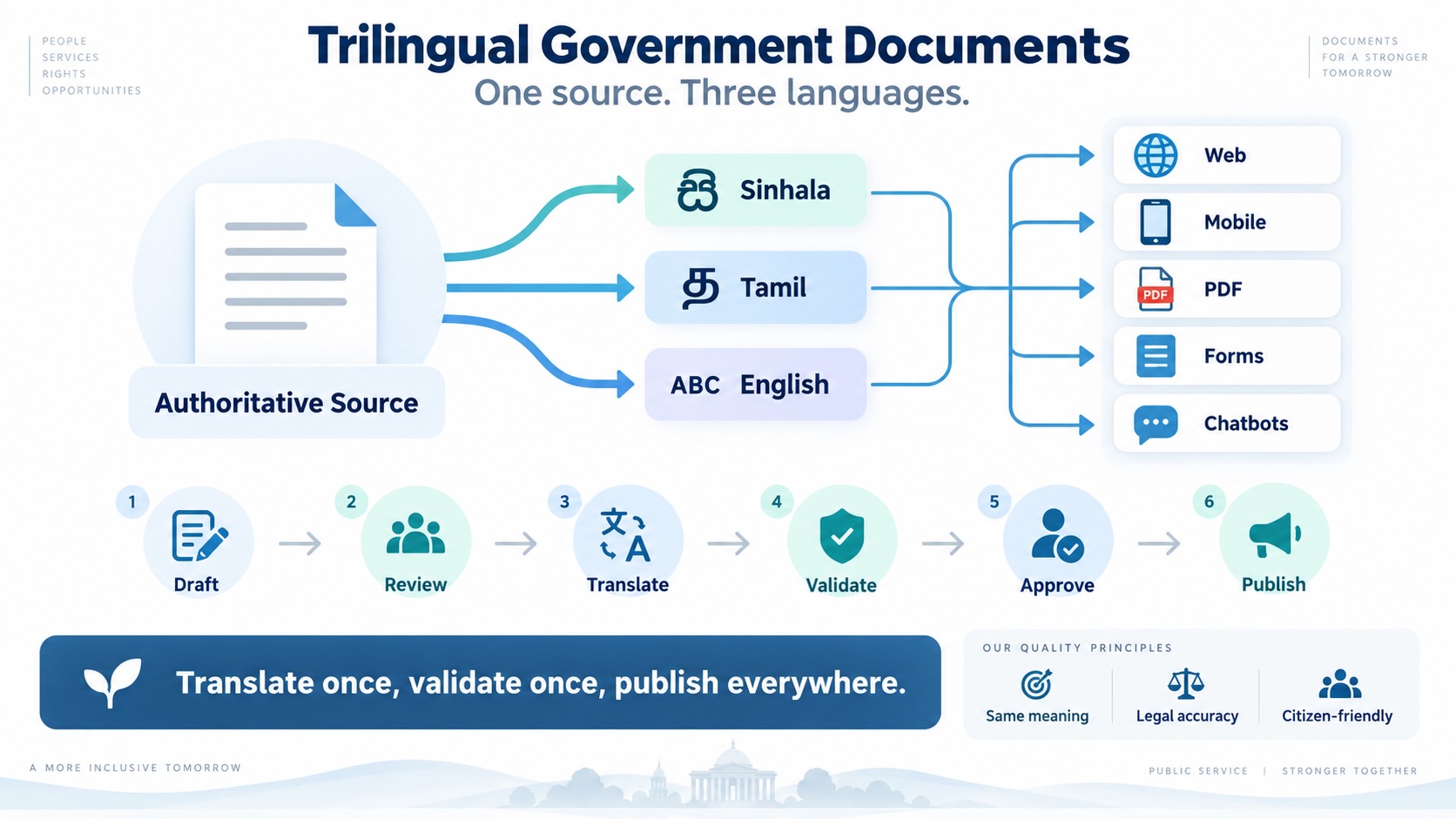
One source, three language editions. My diagram.
Test the model on your documents, not on its reputation
Try more than one engine. The one that impressed you in English is not necessarily the best for your language or your document. So my own rule is this: benchmark Sinhala and Tamil separately using qualified reviewers and representative documents. Fluency and model agreement are insufficient measures of correctness.
A second model’s agreement is a review signal, not independent proof. Models can share errors. And a model asked to judge output leans towards its own — that has been measured.
Having said that, the research that found hallucination concentrating in translation directions with little training data also found that using more diverse models, trained on different data, as fallback systems can improve translation quality. Two systems built on the same data are one opinion twice.
The same goes for feeding the model your own approved files. Retrieval from approved documents can improve grounding; it does not guarantee correct interpretation or output.
The translator is not the person AI replaces
Put the same systems in front of professional translators who can see the whole document and the verdict moves: in one study they produced “a substantially different ranking of evaluated systems from the one established by the WMT crowd workers.” The systems did not change; who was reading them did. So “qualified reviewer” is not a courtesy phrase. It is the thing that decides the answer.
An example from my own desk. We needed a Sinhala cover line for a book about writing the English paper. Three faithful renderings came to me, each correct. I rejected all three and wrote this:
බය නැතුව ඉංග්රීසි පේපර් එකට ලියමු — let’s write the English paper without fear.
Three deliberate moves. A code-mixed borrowed noun, පේපර් එක, the word a parent uses, instead of the formal ප්රශ්න පත්රය. The spoken නැතුව rather than the written නැතිව. And a hortative verb, ලියමු — let us write — inviting the act rather than naming a state.
No model proposed it, because it is not a translation of the English at all. It is a different sentence producing the same feeling in another language — a designer’s decision, made from knowing who is reading and how they speak.
That is the work I want language professionals doing: not tidying machine output at the end, but sitting at the front of it — choosing the terminology, deciding what counts as a critical error in this document, for this citizen.
As I said in one session, in Sinhala: someone has to read it… if nobody reads it, you cannot get the real meaning out of it.
A meaning-preservation checklist for trilingual content
Use it on the next multilingual thing you publish.
- One authoritative source. Every language edition derives from it; nothing maintained in parallel.
- Terminology and names. Look terms up in the Department of Official Languages glossaries; an office name must lead the reader to the actual office.
- Numbers and negations, one at a time. Dates, deadlines and amounts against the source; every not, must and may read aloud, since a softened must is a changed rule.
- Adequacy before fluency. “Does it say the same thing?” before “does it read well?”
- A reviewer who reads the language and knows the subject. A fluent non-specialist can reach a different verdict.
- A second model is a signal, never a sign-off — and prefer one trained on other data.
- Benchmark Sinhala and Tamil separately, on your own documents, and again when you change model.
- A named person signs each edition, and the record says who.
One last thing, which I would rather say than have you notice: this is an essay arguing for Sinhala and Tamil competence, published in English. That is not an apology. It is the inequality I am describing, showing up inside the description.
So, a question for anyone publishing in three languages. Take the last notice you sent out: if a citizen acted only on the Sinhala edition, or only on the Tamil, would they end up in the same place, on the same day, with the same rights as the reader of the English?
If you do not know, that is not a translation problem. It is a design problem — and the people who can solve it are already in the building.
This is the sixth essay in a series asking how people, organizations and nations can turn increasingly capable AI into greater human capability, better services and sustainable economic opportunity.
Next in this series: A07 — Who Still Cannot Use an AI-Enabled Service?
All essays in this series: AI, Human Agency and the Digital Economy
At a glance
- My argument: articulation, interpretation and official terminology are now operating skills, not soft skills, because they are what let a person direct AI and catch meaning that generated text loses.
- In a 2023 study, crowdworkers judged a leading general-purpose AI model’s readings of ambiguous English sentences correct 32% of the time, against 90% for the linguists’ own disambiguations — evidence, as I read it, that fluency and correctness are different properties.
- A Sinhala benchmark of more than 7,000 national-curriculum questions found AI model performance limited overall, and that models struggle in culturally rich subjects such as the Humanities.
- A separate Tamil benchmark of 820 Sri Lankan school examination questions found AI performance declining as linguistic complexity rose, its authors suggesting that performance may be driven by exposure rather than genuine understanding.
- From my own AI workshops with Sri Lankan public officers — my impression from the room, not a benchmarked finding — the squeeze on AI output is tighter for Sinhala than for Tamil, since Tamil has more literature, including from India, to draw on.
Questions people ask
Why does fluent AI-generated text in Sinhala or Tamil still need a human check? Because fluency and accuracy are different properties: a 1994 machine-translation evaluation method scored them separately, judging fluency “without knowing the accuracy of the content.” In an illustrative example I constructed for this piece — not a real notice, no script printed — a single dropped negation flips a deadline from a cutoff into an invitation.
How well do AI models handle Sinhala and Tamil? Not well, and I report the two languages separately rather than as one category, because the published benchmarks measure different things. A Sinhala benchmark of over 7,000 questions found overall performance limited and that models struggle in culturally rich subjects; a separate Tamil benchmark of 820 questions found performance declining as complexity rose. From my own workshops, not a study, the squeeze reads tighter for Sinhala.
What is the Department of Official Languages Terminology Bank? It is a Sri Lankan government resource of 88 subject glossaries, including Law and Public Administration, publishing the approved official wording for government terms. I cite it because the terminology for a trilingual document is usually already published, rather than something a reviewer has to invent from scratch.
Can a second AI model verify that a translation is correct? No. A second model’s agreement is a review signal, not independent proof, because models can share the same errors. I argue for benchmarking Sinhala and Tamil separately, using qualified human reviewers and representative documents, rather than treating model agreement as a sign-off.
What does a trilingual workflow need? Four things: one authoritative source document that every language edition derives from; official terminology drawn from published glossaries; a review by someone who reads the target language and knows the subject; and a named human who signs off on the final page.
Why do human language skills matter more, not less, in the AI era? Because natural language is now the interface to powerful AI, articulation, interpretation and terminology are what let a person direct AI accurately and catch meaning that generated text loses. As I put it above: not soft skills any more — operating skills, and their value is going up.
Sources
- Adequacy and fluency as separate measurements — the ARPA MT evaluation methodologies (AMTA 1994) — where “reads well” and “says the same thing” were formalised as two different scores.
- Language models and ambiguity: the AmbiEnt benchmark (EMNLP 2023) — linguist-annotated ambiguous sentences, and the 32 per cent against 90 per cent result.
- WMT 2021 critical translation error categories, with definitions and examples — the official classes for negation, numbers and names, and what does not count as critical.
- Why professional reviewers rank translation systems differently from crowd workers (TACL 2021) — expertise and document context change the verdict.
- Does training people to prompt actually help? Evidence from journalists (arXiv, 2024) — the field experiment behind the objection to prompting training.
- Why a model is a biased judge of its own output (NeurIPS 2024) — measured self-preference in model evaluators.
- Where translation hallucination concentrates, and what actually reduces it (TACL 2023) — low-resource directions, and the case for fallback systems trained on different data.
- SinhalaMMLU: a Sinhala benchmark built on the Sri Lankan national curriculum (EMNLP 2025) — over 7,000 questions; overall performance limited, and models struggling in culturally rich domains.
- ILAKKANAM: evaluating language models on Tamil, from Sri Lankan school examination papers (arXiv, 2025) — 820 questions; “exposure rather than genuine understanding.”
- The Department of Official Languages Terminology Bank — 88 subject glossaries — the published official terminology; the Department notes the site is being updated.
- The Constitution of the Democratic Socialist Republic of Sri Lanka — Chapters III and IV — the primary text of the language provisions and of Article 12(2).


Leave a Reply