AI, Human Agency and the Digital Economy · Part 4 of 41
AI readiness is a property of a task inside an institution — not of a person, and not of a nation. Here I set out a five-task readiness matrix, built from observable evidence rather than a national score, for judging whether a government office can actually finish the work.
The Department of Census and Statistics is admirably plain about what its own headline measures. Its bulletin defines a computer-literate person as someone who “could use a computer on his/her own”, and gives its own worked example: “even if a 5 year old child can play a computer game then he/she is considered as a computer literate person.” That is a careful definition doing exactly what it says. It is not a measure of whether anybody can finish a piece of work.
Hold it beside a real task. A citizen writes in Tamil and needs an answer from an approved source, checked by someone who can read it. Who in that office is ready? Not literate — ready.
Readiness exists when people can complete useful tasks within supportive institutions and infrastructure. Not a property of a person, and not of a nation: a property of a task inside an institution.
Literate, connected, ready: three different things
Literacy is what a person can do. Access is what is available. Readiness is whether the work gets finished. Our instruments encourage us to blur them: a World Bank review of digital-skills frameworks, written for its Africa digital-economy work, notes that self-reported skills data is “likely to be positively biased”.
Access has the same gap in it. On the figures the Telecommunications Regulatory Commission reported to the ITU for the 2023 reference year, 97% of people lived within range of at least a 4G network. That is a planning statistic about where a signal reaches, not a statement about what a connection does in a particular building on a particular morning — which is a different measurement, and one nobody publishes. I have run sessions where the connection would not hold long enough to finish a demonstration.
Completion is what we hardly measure. The World Bank’s October 2025 appraisal of a Sri Lankan digital transformation project records 14% of adults using the internet to reach government services, and, of those obtaining or renewing a vehicle licence, 3% using the online service as of February 2023 — a service live since 2009.
In the first of these essays I argued that training delivered into an office without those conditions has nowhere to land. This one is about the conditions.
Ready to do what, and for whom?
Readiness means nothing until you name the task and the person. Citizens, public officers, small businesses, professionals and researchers are all being told to become AI-ready.
Citizens need an answer in the language they used. Researchers setting school-mathematics problems independently in Sinhala, Tamil and English found basic arithmetic travelled but complex reasoning degraded significantly in the local languages, which suggests that strong English performance does not guarantee reliable performance across languages. Their work, not mine.
Public officers need somewhere for the work to live. Officers build something useful in three hours and then have nowhere supported to run it — what I have seen in workshops, not a diagnosis of why. A18 takes up the diagnosis.
Small businesses must be counted before they can be assessed. The Asian Development Bank’s 2025 SME monitor is blunt: “Overall MSME landscape data have not been updated since the 2013 Economic Census.” The newest economy-wide count of them is thirteen years old.
Professionals and researchers I cannot evidence at all. The university statistics host has returned a server error every time I have checked, and the national science-statistics page is gone. That absence is itself part of the argument.
What has to be true before the task can be done?
Take that Tamil enquiry again. Language is a workload question: somebody has to check the output, and that hour has to sit in a real person’s day. Connectivity is a worst-day question, not an average one. Computing is the device the work is really done on. Data quality is the age of the record, and who is allowed to correct it.
Then there is permission. In the rooms I teach, permission is the scarcest of these inputs — scarcer than tools. That is a ranking of what I have seen in workshops, not a statement about any institution’s rules.
What I would want to see is a document the person can point to: what may be put into a tool, what may not, who decided, and when it was last reviewed. If the answer is “use your judgement”, the rule is missing — and that is my recommendation about what a rule should contain, not a description of anyone’s rules.
We have written one of that shape before: the Central Bank’s 2019 FinTech sandbox framework makes an applicant identify the regulatory requirements to be relaxed, names who decides, fixes a nine-month window and defines an exit. Financial services only, and the regulator’s own perimeter — but the shape is ours.
Now picture two offices, both constructed for this article — illustrative, not reported.
The first is enthusiastic: people already using tools and building things, with no supported route to put any of it into service. The second is duller and better off — a Lanka Government Network connection, a route onto the Lanka Government Cloud somebody there knows how to use, a budget line, and a named person whose job it is when it breaks.
Both rails are real — ICTA publishes pages for both, updated 30 September 2025. The difference is not a country with hosting and a country without; it is access to the same national rail. Which capabilities we choose to build and sustain is A08’s question; how people learn to use them is A09’s.
Who keeps it running, who pays, who decides?
Three things decide whether the work survives, and nobody has audited them in our offices: this is my own view. Support is a named person whose job this is. Funding is a line that pays for the checking hour, not only the licence. Leadership is whether the decision-maker above the task has ever watched it done end to end.
Miss all three and an office fills with capable people delivering nothing.
A readiness matrix, not a national score
Here is what I would use instead: five representative real tasks — my proposal, not a standard — against eight conditions, each cell something you could go and look at.
| The task | Language | Connectivity | Computing | Data |
|---|---|---|---|---|
| Answer a citizen’s enquiry in Tamil | the last five Tamil replies, and who checked | the worst connection day last month | the device it is typed on | the source’s age, and who corrects it |
| Prepare a committee paper | drafted in which language, tabled in which | whether drafting survives a dropped link | whether the drafter can open the files | which register, and its last update |
| Reconcile a payment file | the statement’s language, and the system’s | whether it runs offline or overnight | a phone, a shared PC, a supported system | who resolves a disagreement between systems |
| Draft and check a professional document | who checks the language, in whose workload | whether the checker can reach it remotely | where it is stored, and backed up | the version of the rule applied |
| Find and verify a figure for research | whether the source exists in that language | whether the source opens from the office | a personal laptop, or a supported environment | the figure’s vintage, and a reachable primary |
| The task | Permission | Support | Funding | Leadership |
|---|---|---|---|---|
| Citizen enquiry in Tamil | the written rule on citizen data | who is called when it fails | the line paying for tool and checking | whether the signer has watched one composed |
| Committee paper | the drafting rule, and who approved it | who fixes the environment, and how fast | which vote the tools sit under | whether the chair knows how it was made |
| Payment file | the rule on uploading financial records, dated | a contract, a colleague, or nobody | the renewal date, and the named payer | whether the owner has sat through a month-end |
| Professional document | the rule on client or case material | whether anyone checks the checker | who pays the checking hour, not the licence | whether the practice head counts it as work |
| Verified research figure | the rule on restricted holdings | who maintains it after the project | whether the compute has a funded end date | whether the reader asked how it was verified |
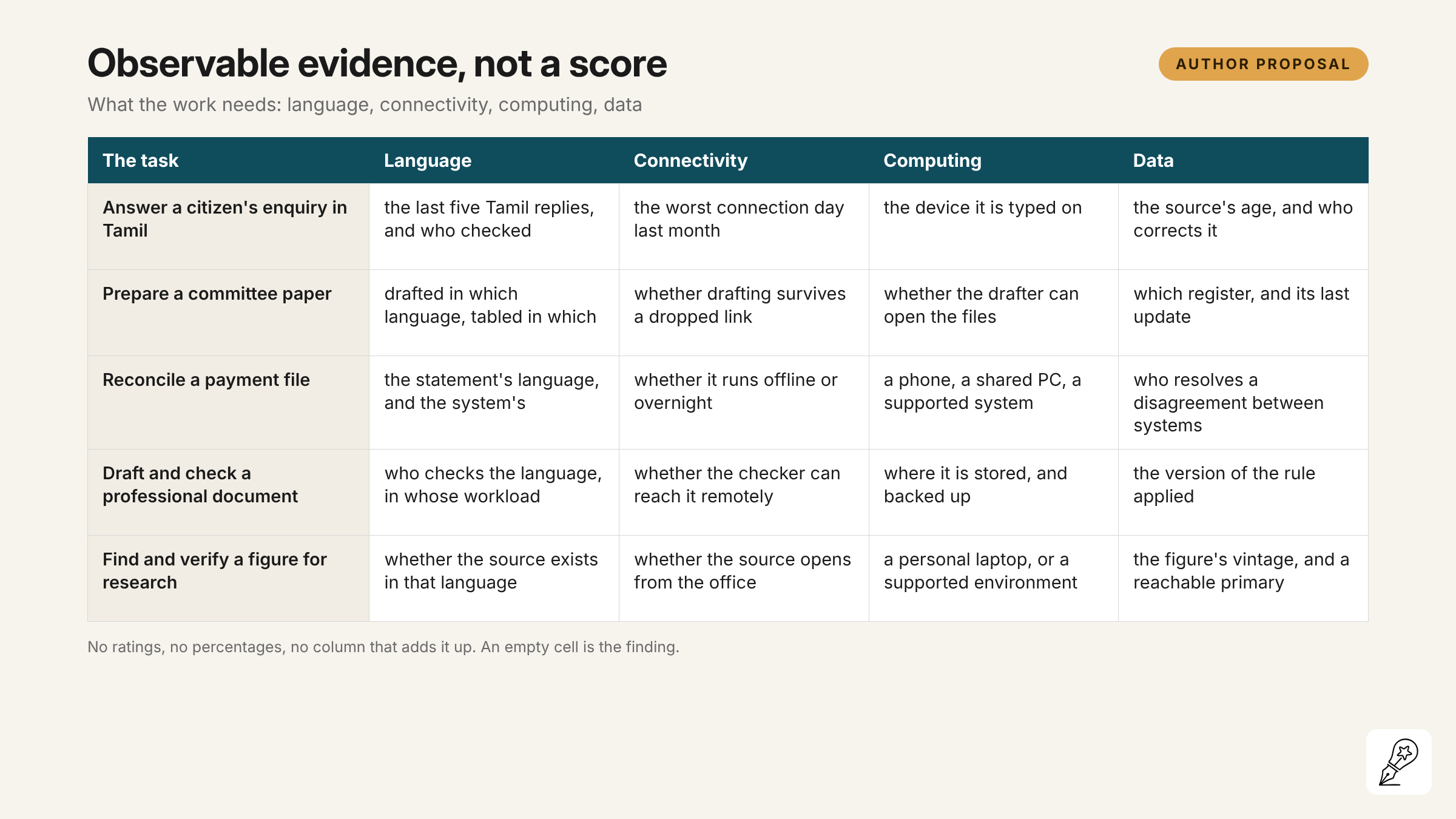
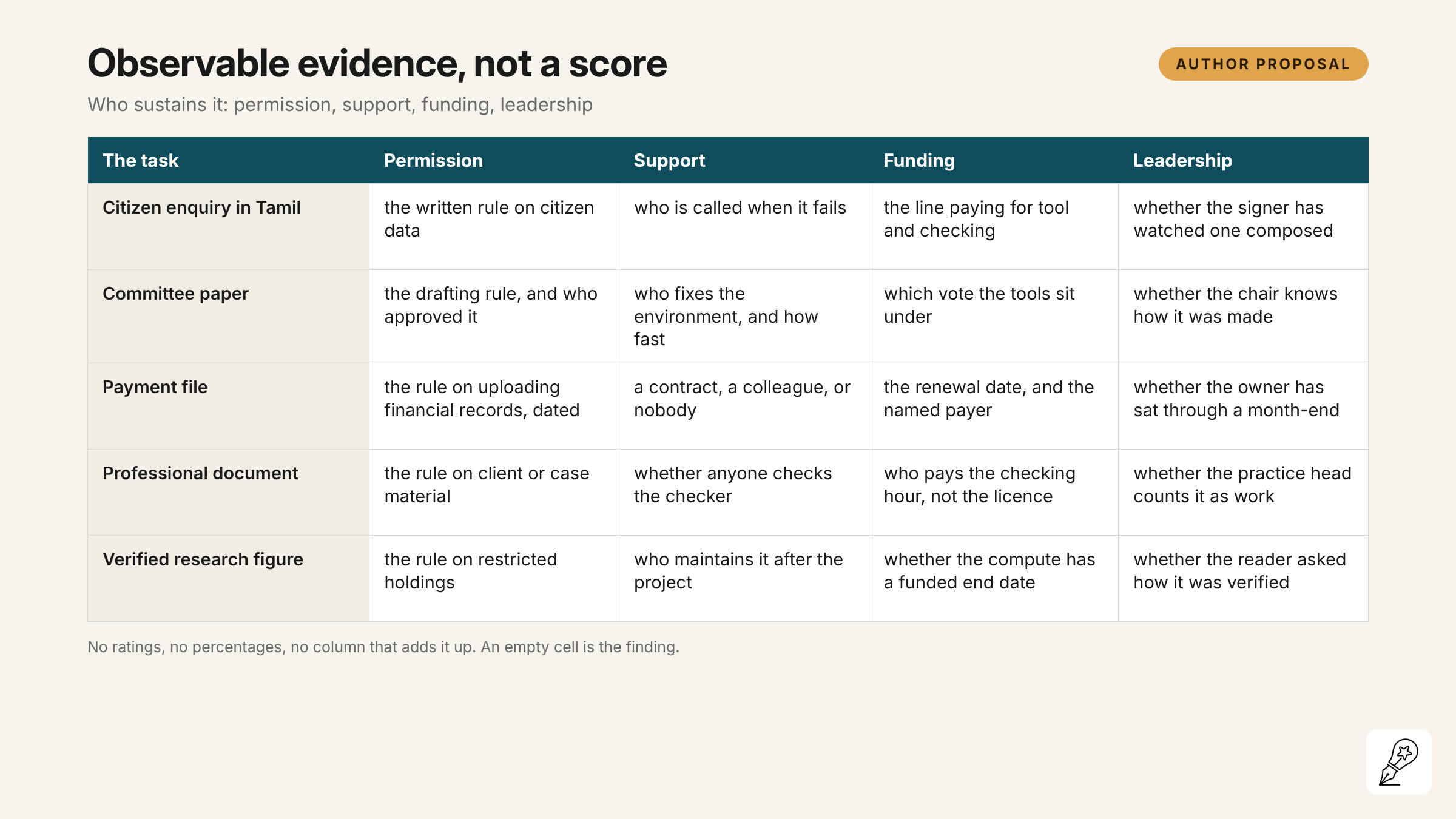
No ratings, no percentages, no column that adds it up: readiness differs by task and by consequence. An empty cell is the finding, and a Permission column full of “custom, not a document” is an intervention list already in priority order.
Start with the evidence, not the form: ask for the artefacts one task needs, and count how many arrive.
The teaching I do with public officers is free to read: the AI for the Public Sector track at Idasara Academy.
But won’t this just become paperwork?
It is the strongest objection, and a score is easier to manage. Sri Lanka sits 80th of the 195 national governments Oxford Insights assessed in its Government AI Readiness Index, published January 2026 — an index built from secondary indices, government self-submission, imputation and link-checked AI-assisted desk research. That is serious work, at the level of a whole government. It is not the question an office faces on Monday.
What a score hides is variation: no number tells you the Tamil enquiry is stuck while the payment file is fine, and those two need different fixes.
So the instrument must be cheap: five rows, not fifty, and evidence a manager already holds. Longer than an afternoon and it gets delegated — which is what the objection predicts.
Nor is my instrument exempt: a department head filling in their own cells is self-reporting, and that caution about positive bias applies to me too. The defence is narrow — the cells ask for artefacts, not opinions, and an artefact can be asked for.
Then do it again
The most useful thing about the matrix is the second time you use it. In the UK, government services are assessed by a panel the team walks through the user journey, and the guidance tells the team to explain what changed since the previous assessment. Guidance there, not a rule here.
Our own precedent is the sandbox above: a fixed window, interim reports, a decision at the end of it.
So set the interval before the first pass, and go through the same tasks again. Progress is not a number going up. It is a cell naming something that did not exist last time: a rule where there was a custom, a budget line where there was goodwill, a person where there was nobody.
If the cells are unchanged, nothing the intervention promised has reached the task, whatever was announced. Better to learn that at the retest than after another round of announcements.
If increasingly capable AI is to become greater human capability, better services and sustainable economic opportunity, it will happen one task at a time, in one office at a time. I have not found another route.
Fourth of thirty-two essays on AI, human agency and the digital economy; the next one leaves the office for the national conversation.
Next in this series: A05 — A National AI Conversation That Changes What Gets Built — coming next.
At a glance
- The thesis: readiness is not a property of a person or a nation — it exists when people can complete real, useful tasks inside supportive institutions and infrastructure. A task is either ready to be done or it is not; a country is not.
- What Sri Lanka’s headline literacy figures actually measure: the Department of Census and Statistics defines a computer-literate person as someone who “could use a computer on his/her own” — its own example is a five-year-old who can play a computer game. On that measure, the Department’s 2025 bulletin puts computer literacy at 39.2% and digital literacy at 72.0%, both to be read with caution given high coefficients of variation and a 2024 Census reweighting, and neither is a measurement of whether a piece of work gets finished.
- Three different things, often blurred: literacy is what a person can do; access is what infrastructure is available; readiness is whether the task actually gets completed, inside an institution that supports it.
- A readiness matrix, not a national score: five representative real tasks — a citizen’s Tamil enquiry, a committee paper, a payment reconciliation, a professional document, a verified research figure — checked against observable evidence (an artefact, a name, a date) across eight conditions. No ratings, no percentages, no column that adds it up; an empty cell is the finding.
- Where Sri Lanka sits on the one global index I engage, and no further: 80th of the 195 national governments Oxford Insights assessed in its Government AI Readiness Index, published January 2026 — an index built from secondary indices, desk research, government self-submission and peer-group imputation. I treat the rank as the thing to argue past, not the frame: no national number tells an office whether the Tamil enquiry is stuck while the payment file is fine.
Questions people ask
What does Sri Lanka’s computer literacy rate actually measure? The Department of Census and Statistics is explicit about what its own measure covers: a person aged 5–69 counts as “computer literate” if they can use a computer on their own — the bulletin’s own worked example is a five-year-old who can play a computer game. On that measure, the Department’s 2025 bulletin puts computer literacy at 39.2% and digital literacy at 72.0%, both to be read with caution given high coefficients of variation and a 2024 Census reweighting. It is a careful, honest statistic doing exactly what it says — and, I would argue, it is not a measure of whether anyone can finish a piece of work.
Is Sri Lanka AI-ready? My answer is that it depends which task, in which office. Sri Lanka ranks 80th of the 195 national governments Oxford Insights assessed in its Government AI Readiness Index, published January 2026 — an index built from secondary indices, desk research, government self-submission and peer-group imputation. I treat that rank as a fact worth knowing, not an answer: a national number cannot tell an office whether a citizen’s enquiry in Tamil can be answered on Monday. My own instrument is a five-task readiness matrix, filled in with evidence a manager already holds, with no aggregate score.
What is the difference between digital literacy and AI readiness? I distinguish three things that get blurred together: literacy is what a person can do, access is what infrastructure is available to them, and readiness is whether a real task actually gets finished, inside an institution that supports it. Sri Lanka’s national digital literacy figure — 72.0% in 2025, per the Department of Census and Statistics, and to be read with caution given high coefficients of variation — describes individual skill. Readiness, as I frame it, is a property of a task inside an institution, never of a person and never of a nation.
How do you assess AI readiness in a government office? I propose testing five representative real tasks — answering a citizen’s enquiry in Tamil, preparing a committee paper, reconciling a payment file, drafting and checking a professional document, and finding and verifying a figure for research — against evidence anyone can go and look at: who checked the last Tamil reply, whether a document survives a dropped connection, whether a written rule says what may be put into a tool. Every cell asks for an artefact, not an opinion or a score; an empty cell is the finding itself.
What question does this series ask? This is the fourth of 41 essays in which I ask: how can people, organizations and nations turn increasingly capable AI into greater human capability, better services and sustainable economic opportunity?
Sources
- Computer Literacy Statistics 2025 — Annual Bulletin — Department of Census and Statistics (PDF; survey January–December 2025, 25,000 households, ages 5–69; 2025 estimates reweighted on Census 2024; the bulletin notes high coefficients of variation).
- ICT Development Index 2025 — dataset — International Telecommunication Union (XLSX; indicator values are for reference year 2023; Sri Lanka’s 4G population coverage is sourced to the Telecommunications Regulatory Commission of Sri Lanka).
- Sri Lanka Digital Transformation (P508317) — Project Information Document, Appraisal Stage — World Bank, 27 October 2025 (PDF; an appraisal document — its proposed components are not facts about today).
- Asia Small and Medium-Sized Enterprise Monitor 2025 — Sri Lanka chapter, p. 187 — Asian Development Bank (PDF).
- Financial Technology Regulatory Sandbox of the Central Bank of Sri Lanka — Framework, Version 1.0 — Central Bank of Sri Lanka, November 2019 (PDF; financial services only; current operating status not verified).
- Lanka Government Cloud (LGC) — ICTA (page last updated 30 September 2025).
- Lanka Government Network (LGN) — ICTA (page last updated 30 September 2025).
- Large Language Models for Math Education in Low-Resource Languages: A Study in Sinhala and Tamil — Kishanthan, Thushalika, Jayasekara & Hevapathige, 16 February 2026 (accepted to ITHET 2026; school-mathematics domain).
- Digital Skills: Frameworks and Programs — World Bank, April 2020 (PDF; background paper for the Digital Economy for Africa initiative).
- Service Standard and What happens at a service assessment — UK Government Digital Service (guidance, not statute).
- Government AI Readiness Index 2025 and Methodology Report 2025 — Oxford Insights, published January 2026 (PDFs; 195 national governments; data from secondary indices, desk research, government self-submission and peer-group imputation).



Leave a Reply