How Our Children Learn: tuition hopping, the Double Reduction policy, learning how to learn, and AI and teachers.
AI does not eliminate good teachers; rather, it empowers both the teacher and the students. That is what I believe, and I want to show you why, along with the conditions under which it stops being true.
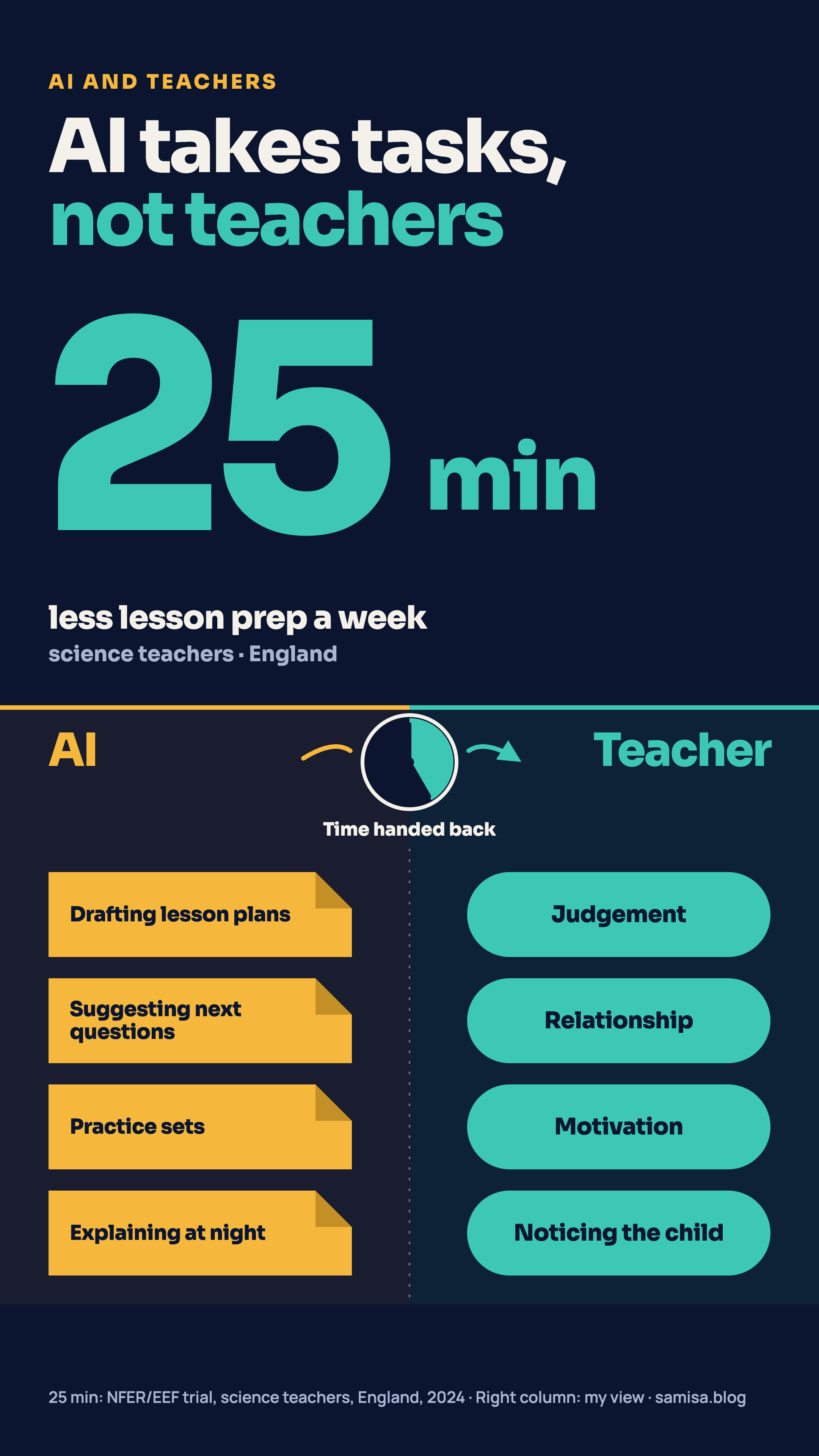
In simple terms: AI takes tasks, not teachers. It can draft a lesson, suggest the next question and explain a sum at nine at night. What it does not do is decide what a child needs next, or notice when a child has gone quiet. And it helps the student most when it supports their thinking instead of doing it for them.
This piece is for two readers at once. If you are a teacher, you may be wondering whether AI will make you unnecessary, and how to use it without short-changing your students. If you are a parent, you may be wondering whether your child still needs a teacher, or a tuition class, when AI can explain everything. I think the evidence gives you both the same answer.
Why is everyone asking this now?
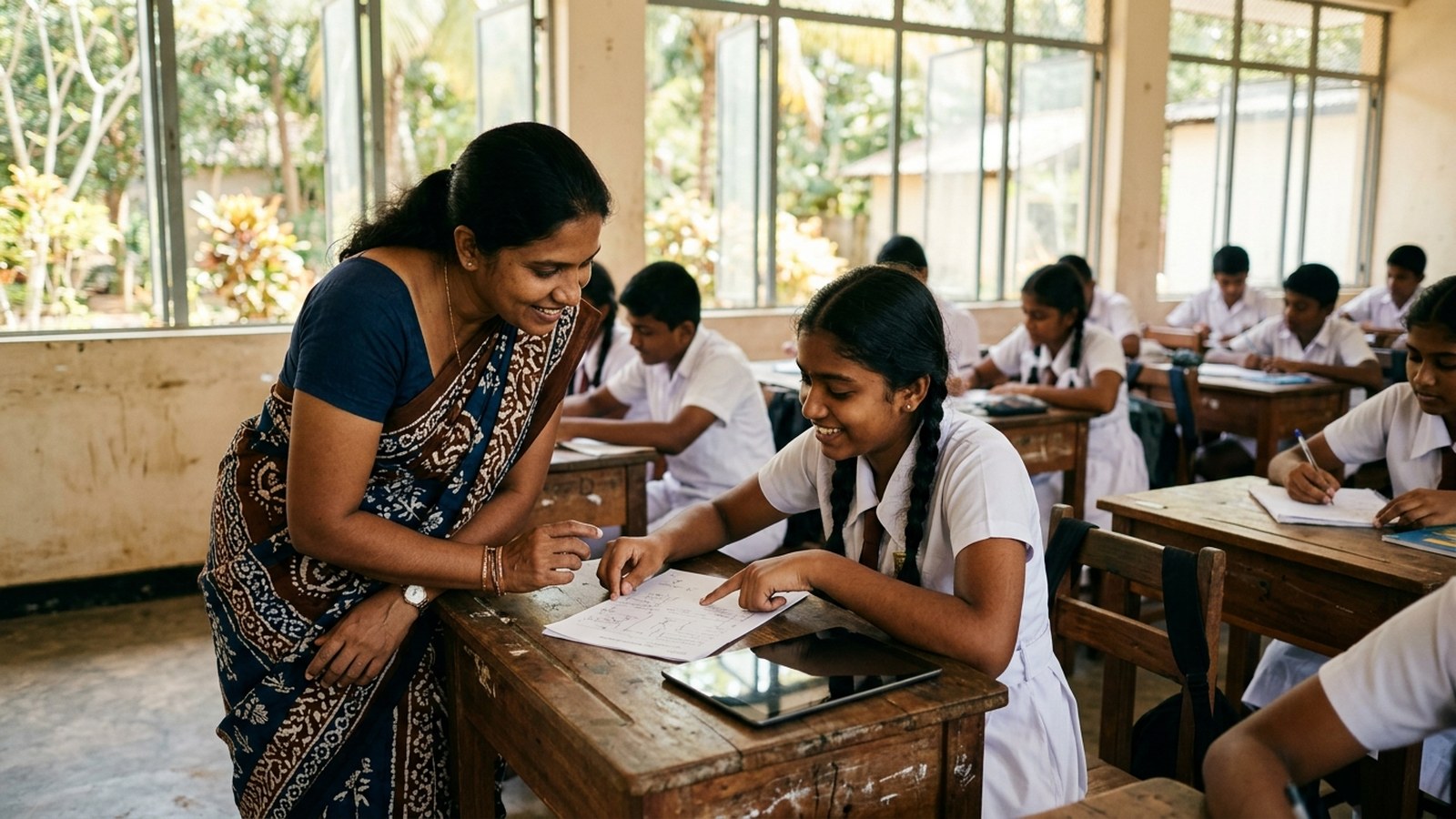
Because AI has walked into the classroom, and the fear has walked in with it. It’s a trend, and a loud one. It can feel as if every week brings another tool that marks, plans or tutors.
Having said that, look at what Sri Lanka is actually short of. According to Education Ministry data released under the Right to Information Act and reported by The Morning on Sri Lanka’s teacher vacancies, 40,185 teacher vacancies remained unfilled at the end of 2025, and only 425 teachers had been recruited in 2026 as at 15 September. The shortage is not only ours. In February 2024, a UNESCO report said the world needs 44 million teachers by 2030, as UN News reported at the time.
We do not have too many teachers. We have too few.
What about the jobs themselves? The International Labour Organization’s 2025 index of exposure to generative AI rates primary and secondary school teachers in its lowest band, “Not Exposed”, where most tasks remain relatively unaffected. University and vocational teachers are rated “Minimal Exposure”, and education methods specialists and trainers score higher.
Read that carefully, because the authors do. They write that “such exposure does not imply the immediate automation of an entire occupation, but rather the potential for a large share of its current tasks to be performed using this technology.” Their view is that “transformation of jobs is the most likely impact of GenAI”. The index is global, it has no Sri Lankan figure, and it is a rating, not a forecast. Still, it points the same way I do: the change is in the tasks.
What does AI do for the teacher?
The best evidence I found is about time and about guidance.
On time, a trial run by NFER for the Education Endowment Foundation and the Hg Foundation in England looked at ChatGPT in lesson preparation. In a ten-week trial with 259 science teachers in 68 schools, those using ChatGPT to prepare lessons spent about 25 minutes a week less (56.2 against 81.5 minutes), and an expert panel found no difference in the quality of what they made. The teachers put the saved time into other lesson and resource planning, into teaching tasks, or into reducing their overall workload. Only lesson preparation was measured. Not marking, and not what students learned.
Twenty-five minutes a week is not a revolution. It is time handed back to a teacher, one task at a time.
On guidance, the Tutor CoPilot study is the one I find most interesting, because the AI never spoke to a child. It whispered to the tutor. In a randomised trial with more than 700 tutors and 1,000 students in a US school district, students whose tutors had an AI assistant suggesting how to respond were 4 percentage points more likely to master the day’s maths topic. For students of lower-rated tutors, the gain was up to 9 points. The tutors could edit or ignore every suggestion, and the authors describe the change as “increasing probing questions and reducing generic praise”.
Now the honest part. The researchers found no statistically significant improvement in end-of-year maths test scores, after about two months. The tutors were mostly novices on a virtual tutoring service, working with grades 3 to 6 in low-income schools where most students were Hispanic. The paper is a preprint, and the authors themselves say the tool “may be less effective for experienced educators” and in “other countries”.
So I read it this way. AI helped novice tutors ask better questions, day by day. It did not, on its own, measurably move the year-end result. That is a tool that empowers a teacher. It is not a replacement for one.
What does AI do for the student?
Here the evidence splits in two, and the split is the whole point.
When AI guides, it can help a great deal. World Bank researchers describe a six-week after-school pilot in Edo State, Nigeria, run in mid-2024. Students randomly assigned to AI-assisted English sessions, run with teacher support, outperformed those who were not. The researchers put the gain at about 0.3 standard deviations, which by their own conversion is nearly two years of typical learning. They report that participants also did better in their end-of-year school exams, and the full evaluation was, in their words, “soon to be published”. Their conclusion is careful: AI “when implemented thoughtfully with teacher support, can function effectively as a virtual tutor”. They also say the long-term effects are still an open question.
At Harvard, a tutor built on the same teaching practices as the class helped physics undergraduates learn more in less time, measured immediately after the lesson.
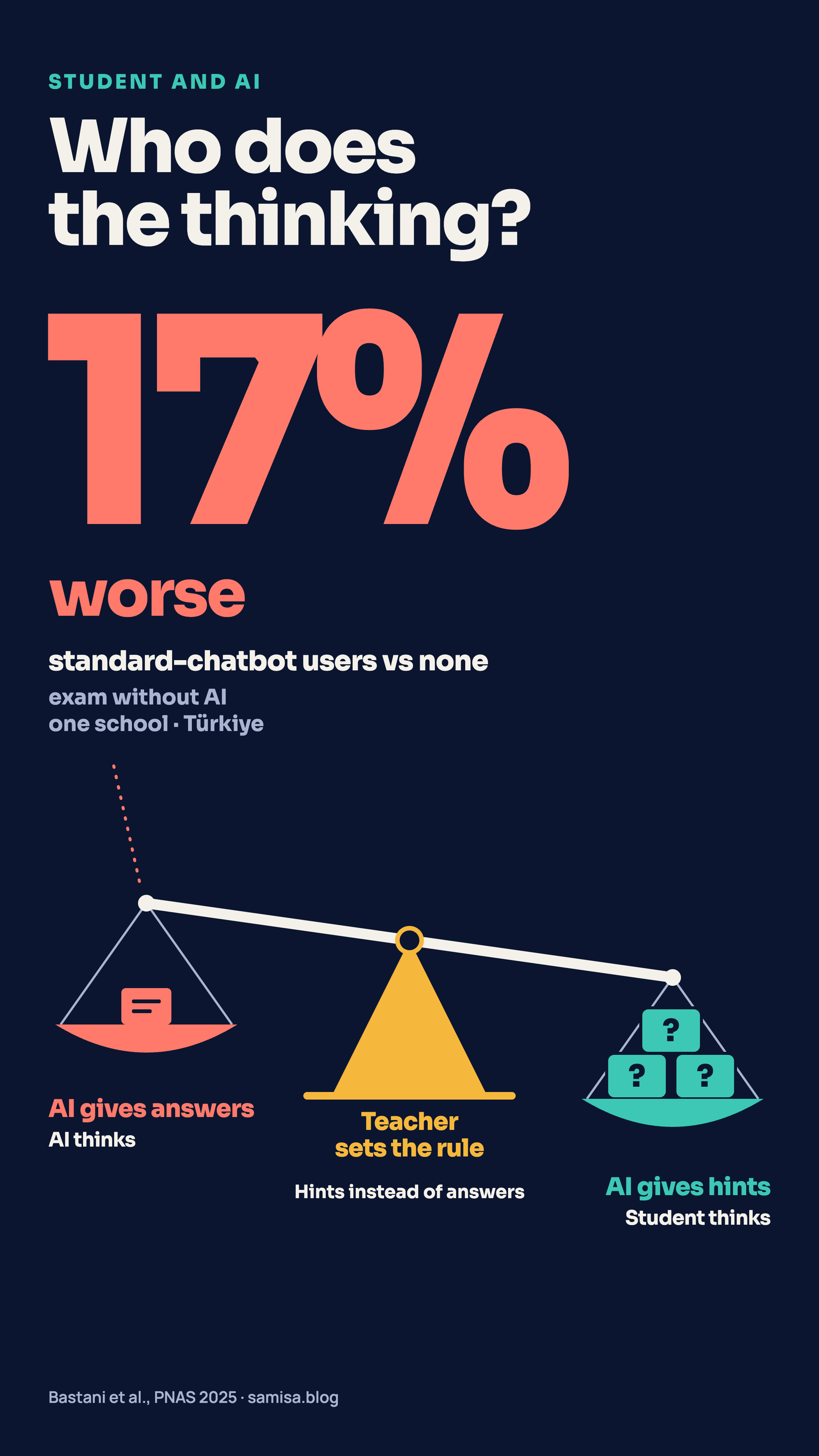
When AI answers instead, it can do harm. In Generative AI without guardrails can harm learning, researchers worked with nearly a thousand high school maths students at one school in Türkiye. When the AI was taken away, those who had used a standard chatbot did 17% worse than students who never had it, on an exam taken without AI. A tutor version that gave teacher-designed hints instead of answers largely mitigated that harm.
I wrote about this side at length in Question Everything, With AI, along with a short online study of adults who solved fewer problems once the AI was taken away, and in some experiments gave up more often, especially those who said they had asked it for answers rather than hints. I will not repeat it here. The lesson I take is simple: AI that does the student’s thinking can lower what the student can do alone. AI that supports the student’s thinking can raise it.
One honest limit before I go further. None of these trials studied Sri Lankan students or teachers. They come from the United States, England, Nigeria and Türkiye, and I am reading across from them. Please read me with that in mind.
Why does the word “good” matter?
Look at what the studies that worked have in common. In Nigeria, there was teacher support. In Türkiye, the version that avoided most of the harm used teacher-designed hints. In Tutor CoPilot, the AI worked through a human tutor who could ignore it. Every trial that worked had a teacher, or a teacher’s design, inside it.
That does not prove that AI alone can never work. It is what these studies cover, and nothing more. Having said that, it is why my sentence says good teachers.
What follows is my own reasoning, not a research finding. I could not find a study that measures it, so take it as my view.
I think a good teacher does at least three things that AI does not do for a child. The first is judgement: deciding what this child needs next, and what matters in a syllabus that is too long to cover evenly. The second is relationship: being someone a child does not want to let down. The third is motivation: noticing the quiet one at the back, and knowing when to push and when to wait.
When AI makes the routine work cheaper, I believe those three become worth more, not less.
Some teachers here are already learning to use these tools. In 2024, CEMCA, the Commonwealth of Learning and the Ministry of Education ran a three-day “Workshop on AI for Teachers” in Colombo for 30 educators. In August 2025, the Ministry, the University of Moratuwa and SLAAS ran an applied-AI training programme for schoolteachers in Sinhala, streamed to six regional venues, and repeated it in Tamil at four venues in October. These were training events, not a national policy, and I have seen no outcome data from them. Still, they tell me some teachers here are stepping forward, not back. Internationally, UNESCO has published an AI competency framework for teachers (2024).
What have we built at Idasara?
At Idasara, we start from the student, and from honesty about where an answer comes from. That is the philosophy behind our approach to learning how to learn, which I set out in Learning How to Learn: The Five Pillars Behind Idasara Academy.
In practice, it shows up in one small design choice I care about. On Idasara Academy, the AI tutor labels its answers. One it can check against the curriculum is marked “Verified against curriculum”. One it cannot is marked “Check with your teacher”. A checked answer can also name the curriculum sources behind it and tells the student to open their own textbook, because the textbook wins. When the AI is unavailable, it falls back to real course content instead of guessing.
In my view, that is what “AI takes tasks, not teachers” looks like inside a product: when the AI is unsure, it sends the student back to the teacher.
For teachers, Idasara’s AI Hub has a track written for you, in Sinhala, English and Tamil. You will find it, along with the rest of our work, through Idasara Academy.
What can you do this term?
If you are a teacher: let AI draft one routine task this week, a set of practice questions or a first lesson outline. Check it, fix it, and make it yours. Then spend the time you saved on one student. Just one. The one you have been meaning to sit with.
If you are a parent: ask your child’s teacher how they want AI used at home. For hints or for answers? Before homework, or after? A teacher who knows your child is the best person to set that rule, and your asking tells them you are on the same side. One more point to weigh: UNESCO’s 2023 guidance on generative AI in schools “sets an age limit of 13 for the use of AI tools in the classroom and calls for teacher training on this subject”. It is a recommendation, not a Sri Lankan rule, but it is worth knowing if your child is younger.
AI will keep getting better at tasks. That is not a threat to good teachers. It is an invitation: to hand over the routine, to keep the judgement, and to spend more time on the part of teaching that was always the point. The child.
Sources
- Wang et al., Tutor CoPilot: A Human-AI Approach for Scaling Real-Time Expertise, arXiv:2410.03017 v3 (10 Oct 2026). Preprint.
- NFER for the Education Endowment Foundation and Hg Foundation, ChatGPT in lesson preparation: A Teacher Choices Trial (12 Dec 2024).
- World Bank Blogs, From chalkboards to chatbots: Transforming learning in Nigeria, one prompt at a time (9 Jan 2025).
- Kestin et al., AI tutoring outperforms in-class active learning, Scientific Reports (2025).
- Bastani et al., Generative AI without guardrails can harm learning, PNAS (2025).
- Liu et al., AI Assistance Reduces Persistence and Hurts Independent Performance, arXiv (2026). Preprint.
- Gmyrek, Berg, Kamiński et al., Generative AI and Jobs: A Refined Global Index of Occupational Exposure, ILO Working Paper 140 (May 2025).
- The Morning, Teachers’ shortage in 2026: 40,185 vacancies, just 425 recruits, Buddhika Samaraweera (22 Sep 2026).
- UN News, UN issues global alert over teacher shortage (29 Feb 2024).
- Commonwealth of Learning, Enhancing teaching practices with AI in Sri Lanka (19 Jul 2024).
- SLAAS Section E3, Applied AI in Education (2025).
- UNESCO, AI competency framework for teachers (2024).
- UNESCO, Governments must quickly regulate generative AI in schools (7 Sep 2023).


Leave a Reply