How Our Children Learn: tuition hopping, the Double Reduction policy, learning how to learn, and AI and teachers.
When a child hops from class to class across the week, the cost is not only the fees and the bus fares. It is the time a child needs to make what was taught at school their own.
I am not saying tuition is wrong. A family may keep a class it trusts. I am asking us to count what the hopping costs, and to protect the time for study at home.
In simple terms:
Tuition hopping is taking time away. Bring back the time to kids: let them learn at the school and study at home.
I have come at this from two other directions. In A Child’s Own Hour, I argued for one protected hour a day. In Why Sri Lanka’s Exam Machine Is Failing Our Children, I argued that the system, not the child, is at fault. This piece is about something more ordinary: the week itself, the classes, the travel to and from them, and what is left at the end.
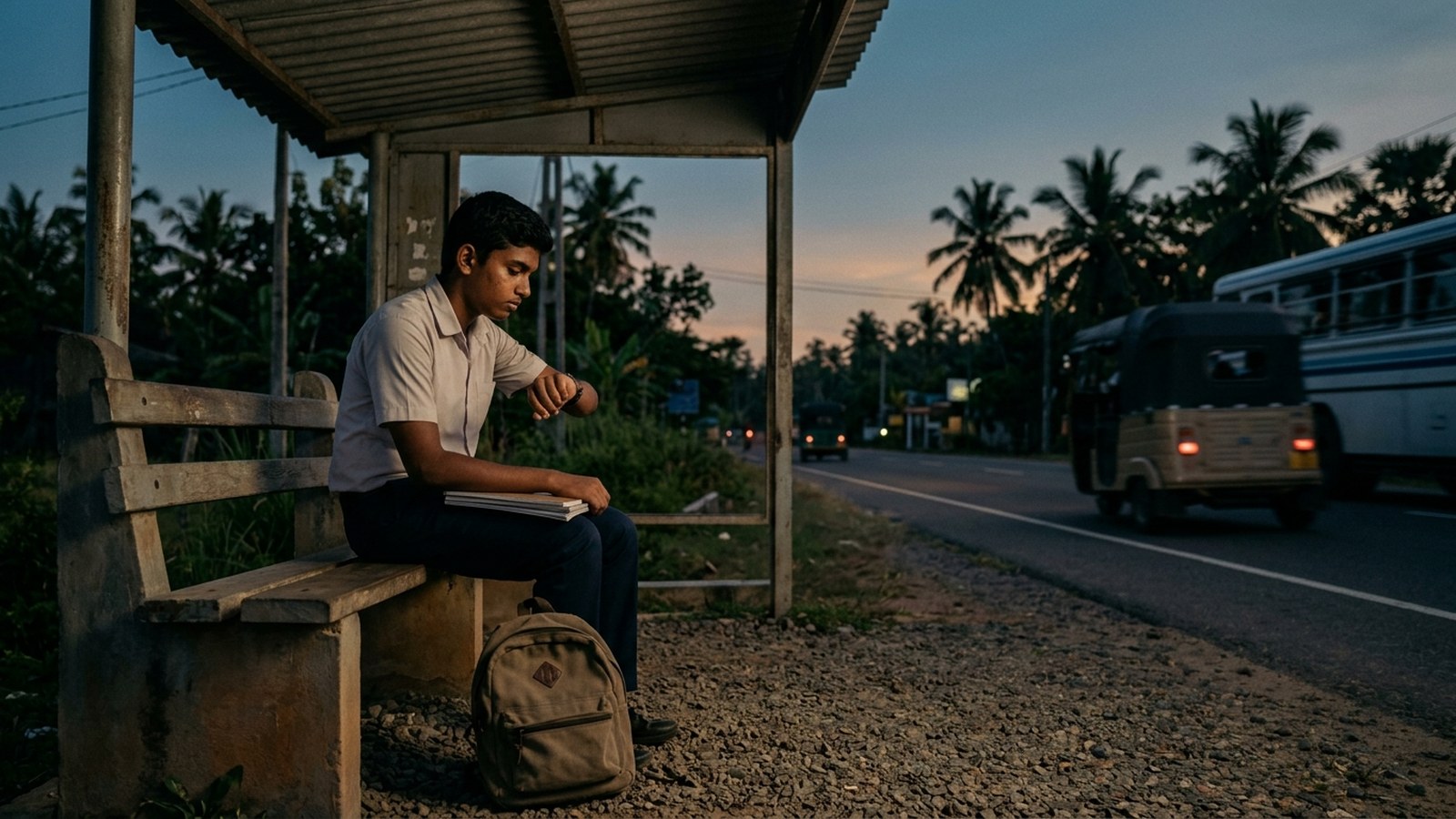
Why talk about tuition now?
Tuition is in the news again, and the government’s own words on it, from February 2025 and September 2026, are worth reading.
On 15 February 2025, at Jaffna Hindu College, Prime Minister Harini Amarasuriya said: “We acknowledge that the tuition industry has flourished due to shortcomings in the education system.” She went on: “we must ensure that schools provide an exceptional standard of education, reducing the reliance on tuition.”
On 8 September 2026, the Education Ministry told The Morning that it is not moving to regulate tuition. “There is no policy decision taken by the Government, despite widespread news suggesting otherwise.” And: “Tuition classes are private institutes that are not registered anywhere, so we cannot regulate them.”
The clearest national limit I could find is temporary: the Department of Examinations bans exam-related tuition in the run-up to a national exam. Before the O/L in February 2026, it banned all tuition classes, lectures, seminars and workshops related to that exam until it ended, and warned of legal action. In 2021, China went much further, and I look at what happened there in Double Reduction, Five Years On.
Put those together and the picture is plain. The government says schools should make tuition less necessary. It also says it cannot regulate tuition. So, for now, the decision about a child’s week sits with the family. With us.
And the habit runs deep. In Sri Lanka’s Household Income and Expenditure Surveys, the share of households with students aged 6 to 21 that spent money on private tuition rose from about 23% in 1995/96 to about 64% in 2006/07. In their 2014 monograph on regulating private tutoring for the public good, Bray and Kwo name Sri Lanka as a place where shadow education, the term they use for private tutoring alongside school, “has become entrenched in society and has become a social norm”.
A social norm is hard to step out of alone. That is why it is worth counting before we follow it.
What does a week of hopping actually look like?
Here I wanted measured numbers, and I have to tell you up front how thin they are.
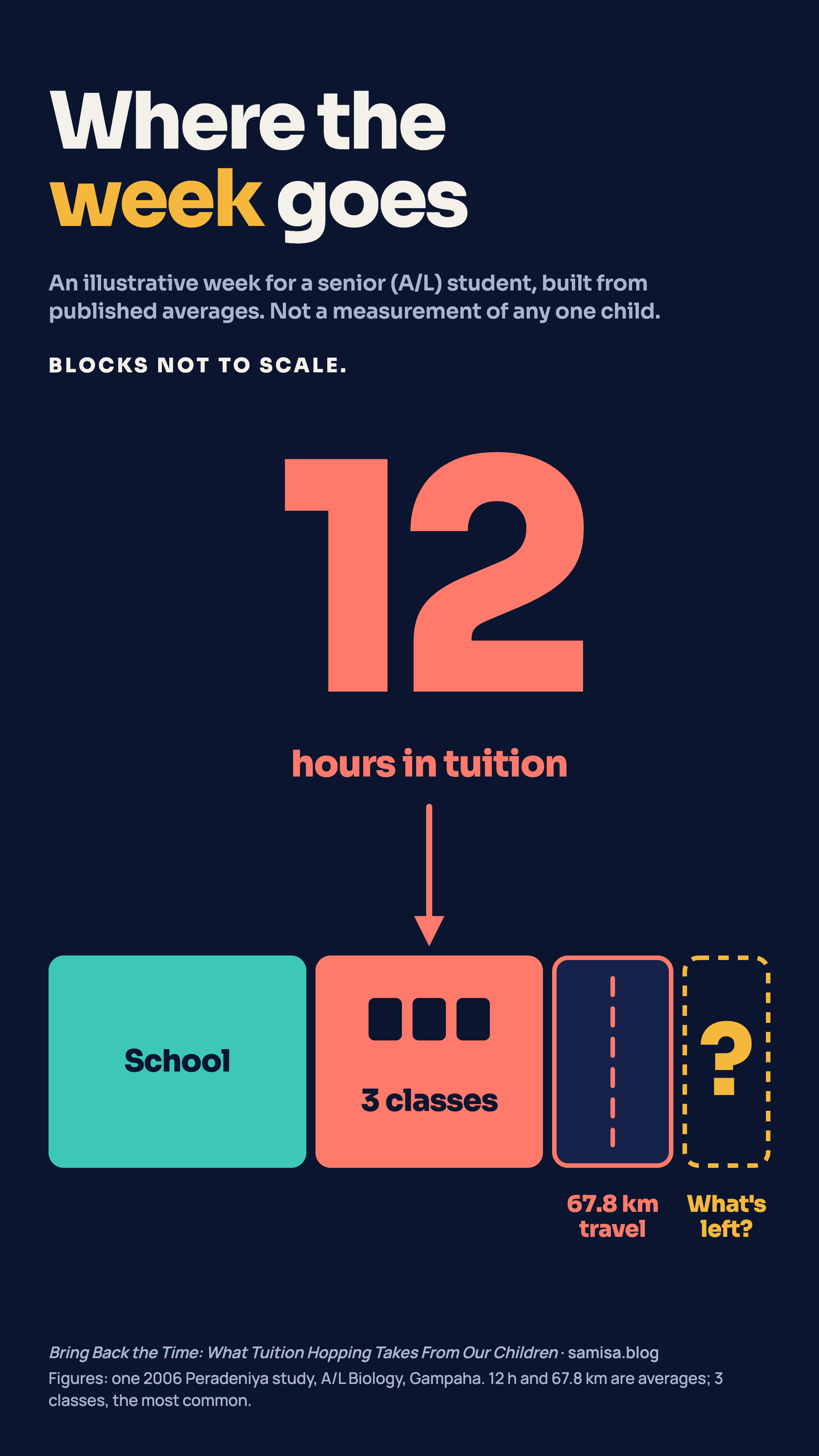
The most detailed I found is a University of Peradeniya study of A/L Biology students in Gampaha district (2006). They spent 12.16 hours a week in tuition on average, anywhere from 2.5 to 32 hours, across one to seven classes. Most (68.2%) attended three. They travelled 67.8 km a week on average to get there, and the average distance from home to a class was 12.3 km.
That is hopping, measured: several classes a week, and the travel to reach them, on top of the school day.
The same study found that Grade 13 students’ school attendance was weaker than Grade 12’s, with heavy absence in the last six months before the exam. It cannot tell us why. But a week holds only so many hours.
A second figure points the same way. Bray and Kwo, reporting a 2009 Sri Lankan study by Gunasekara, write that senior secondary students were “commonly spending 15 to 21 hours a week in extra classes”. Not every senior student: in the same survey, 41.1% of rural and 49.5% of urban students in Grades 12 and 13 received tutoring. Writing about schedules like these in Sri Lanka and Taiwan, Bray and Kwo describe “a crowded schedule dominated by academic work and with little time for sports, socialisation and relaxation”.
Now some illustrative arithmetic. Take the Gampaha average of about 12 hours in tuition classes. The study measured distance, not time, so here is my assumption, not a measurement: at 20 km an hour, 67.8 km is about 3.4 hours on the road. On that assumption, it comes to more than fifteen hours a week outside school.
Please read that as an illustrative week for a senior (A/L) student, built from published averages, not a measurement of any one child. The numbers come from one district and one subject, and they are old. I would not apply them to an O/L student or a younger child.
Here is the number I could not find at all: how many hours are left for a child to study alone. We count the classes, the fees and the kilometres. Nobody seems to count the hours that are the child’s own.
What happens in the hours at home?
A class can explain. It cannot remember for your child.
The remembering is built when the child closes the book and tries to bring the idea back without help. In a well-known experiment, Roediger and Karpicke had students either restudy prose passages or try to recall them from memory. Restudying did better on a test five minutes later. Two days and a week later, recall had won: “prior testing produced substantially greater retention than studying, even though repeated studying increased students’ confidence in their ability to remember the material.” Those were university-age students in a laboratory, not Sri Lankan schoolchildren.
A 2013 review of ten study techniques rated practice tests and distributed practice, which means spreading study out over time, as “high utility”. Underlining and rereading were rated of “surprisingly low utility”.
Having said that, a good class can include practice tests too. In a 2025 study in the Matale zone, 44.0% of A/L physics students said regular tests in tuition helped them track their progress. The research is really about how time is used, not where.
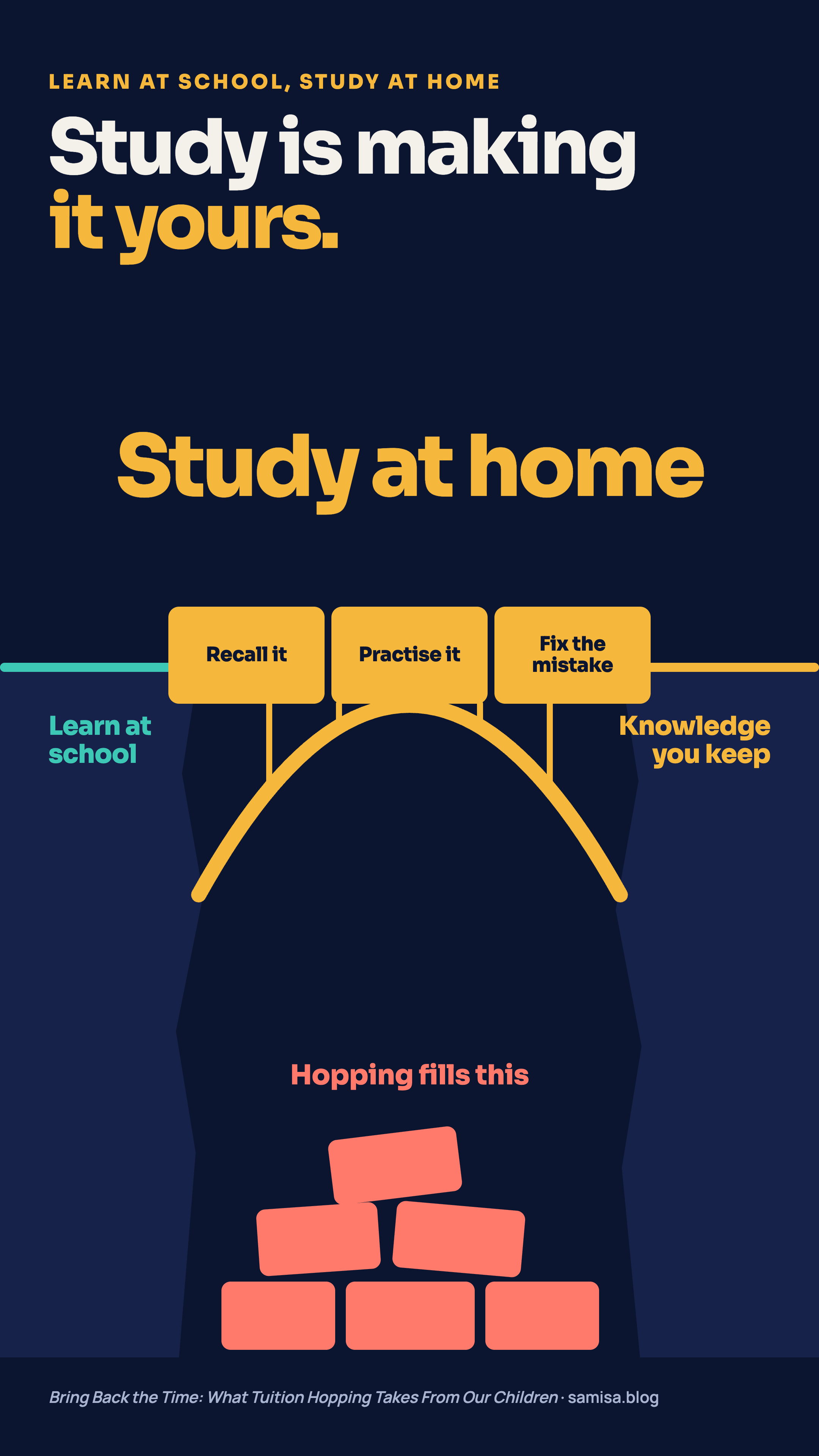
So here is my claim. Home is where a child can space the work out, test themselves on a blank page and fix their own mistakes, at their own pace, with nobody else holding the pen. Hopping squeezes exactly those hours. Each extra class adds more to take in, and leaves less time to keep it.
That is what I mean by learn at school, study at home. Learning is meeting the idea, with a teacher. Study is making it yours.
Doesn’t tuition help?
Often, yes. This is the strongest objection to my case.
Bray and Kwo write that some dimensions of private tutoring are “very beneficial”, and that it “can help slow learners to keep up with their peers, and can stretch the achievements of fast learners.” They also name the other side: “Students and their families may suffer from pressure with extra classes on top of schooling, and some forms of tutoring are a costly item for household budgets.”
The controlled evidence is real too. A 2020 review of tutoring experiments, one-to-one or small-group programmes from preschool to Grade 12, found a pooled effect of 0.37 standard deviations (the researchers’ measure of how big a difference is). Effects were stronger with teachers and paraprofessionals (classroom assistants) as tutors, and programmes during school tended to beat those after school. Those were structured programmes, mostly in Western countries, not large evening classes in Sri Lanka. But good teaching, given closely, works.
Students value their classes, too. The Matale study covered 332 A/L physics students at five schools. Of them, 99.4% attended private physics classes, and about 85% felt those classes were more supportive than school lessons. Those are students’ perceptions, not results, but I take them seriously. The same study reports that “Both students and teachers suggested that a balanced combination of private tuition and school-based instruction is essential”.
Then there is the question every parent asks. If I cut a class, won’t my child fall behind? Honestly, I do not know. I could not find a Sri Lankan study that compares students who went to fewer classes with students who went to more. In the Gampaha study, about one in ten of the 49 past students had spent 20 to 25 hours a week in tuition, and that group did better in the exam. That is about five people, with no controls, so it cannot show the hours caused it, but it is the honest objection.
So I am not asking any family to walk away from a class that works.
Which classes earn their hours?
In simple terms: learn at school, study at home, and keep a class where it earns its hours.
How do you know whether it does? I would ask three questions of every class in the week. What does this class give my child that school does not? What does it cost in hours, with the travel counted? Would those same hours do more as study at home?
A class that answers the first question well is worth keeping. A class that is there only because everyone else goes is worth a second look. And a week with no hours left for study at home needs its next hour at home, not in another class.
In September I put it this way: what matters is how much time a student spends reading, writing, thinking (and chatting) on the subject, to get to the depth of it. Classes can feed that. They cannot do it for the child.
What I built Idasara around
This is where my own work comes from. I built Idasara Academy around an idea we call Me Time: your learning, your pace, your focus.
The design follows from that. Each day the app suggests one clear next step: what to study today. A student can photograph a handwritten answer and get AI feedback on it, and the mistakes become their own practice set. The AI study coach labels its answers, showing whether they can be checked against the curriculum, and it falls back to real course content instead of guessing.
None of that replaces a teacher. It is meant for the hours at home. I explain the thinking behind it in Learning How to Learn. You can see the Academy itself at Idasara Academy.
What can you do tonight?
Tonight, sit down with your child and write their week out, hour by hour. School. Each class. The travel to and from it. Then circle the hours that are their own, for study at home.
If there are almost none, you have learned something I could not find in any survey. Either way, find one hour and protect it.
Before you add another class, ask what it will take from that circle. And if you are thinking of dropping one, talk it through with your child and with the teacher you trust. The decision is yours, not mine.
I cannot promise you a grade. Nobody honestly can. What I can say is that a child who has time to study at home has a chance to make what they learn their own.
Count the week. Keep the class you trust. Bring back the time.
Sources
- Ada Derana, report of Prime Minister Harini Amarasuriya’s remarks on tuition at Jaffna Hindu College (15 Feb 2025).
- Dhanushka Dharmapriya, Role of Education Council: Not moving to regulate tuition: Ministry, The Morning (8 Sep 2026).
- Newsfirst, report on the Department of Examinations’ ban on O/L tuition classes before the February 2026 exam (10 Feb 2026).
- Pallegedara, Demand for private tuition classes under the free education policy: evidence based on Sri Lanka, MPRA Paper 31969 (2011).
- Bray and Kwo, Regulating Private Tutoring for Public Good, CERC Monograph 10, University of Hong Kong (2014).
- Senapala, Private tuition attendance by G.C.E. (A/L) biology students: a case from Gampaha district, University of Peradeniya repository (2006).
- Roediger and Karpicke, Test-enhanced learning, Psychological Science 17(3) (2006).
- Dunlosky et al., Improving Students’ Learning With Effective Learning Techniques (APS summary, 2013).
- Mohamed and Vitharana, Impact of private tuition on G.C.E. Advanced Level physics learning in Matale educational zone, Sri Lanka, RESCON 2025, University of Peradeniya (2025).
- Nickow, Oreopoulos and Quan, The Impressive Effects of Tutoring on PreK-12 Learning, NBER Working Paper 27476 (2020).


Leave a Reply