What is in the new Grade 6 subject, why I welcome it, and what I hope comes next
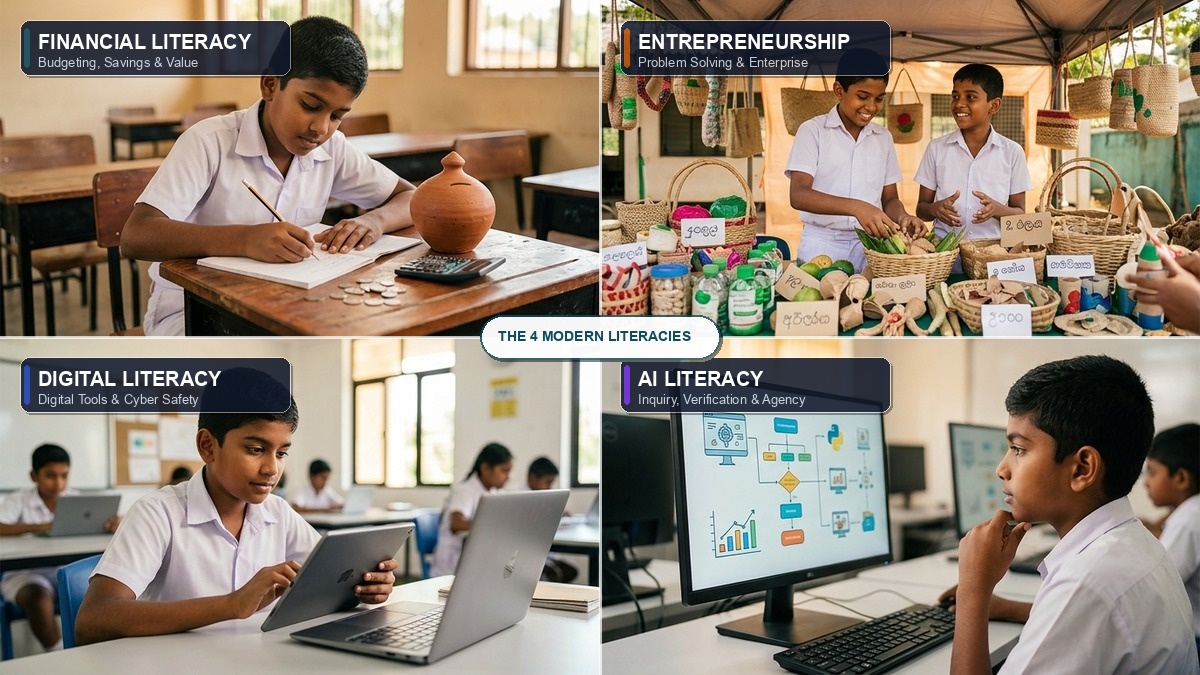
In short: From 2027, Grade 6 students in Sri Lanka will study a new subject, Entrepreneurship and Financial Literacy. I read the first-term module. It starts with the child and not with money: my skills, my dream, a problem I can solve. I think this is a timely and valuable move. My wish is that digital literacy and AI literacy follow it into the classroom.
On Monday, 5 October 2026, the Prime Minister, Dr Harini Amarasuriya, rang the opening bell at the Colombo Stock Exchange, at its 40th anniversary celebrations at the World Trade Center. There she said that a new subject on entrepreneurship and financial literacy will be introduced for Grade 6 students from 2027, and that the curriculum reforms will give students from Grades 6 to 9 this knowledge.
This is a timely and a valuable move.
We teach children compound interest as a formula. Do we teach them what to do with the first hundred rupees that comes into their hands? A student can do well in mathematics and still walk into adult life with no practice in tracking money, budgeting or saving towards something. So I welcome this decision wholeheartedly.
Having said that, I wanted to know what is actually inside the subject. So I went and read it.
What is inside the Grade 6 subject?
The National Institute of Education has published the Grade 6 first-term module for Entrepreneurship and Financial Literacy on its Channel NIE page for Grade 6. It is a short activity book written by the Department of Commerce of the NIE, and it is called Vision for Life.
According to its introduction, Grade 6 students study three modules in this subject, one for each term, and the subject is expected to run from Grade 6 to Grade 11. The module still says 2026 in places. The Prime Minister’s date for Grade 6 is 2027. EconomyNext reported in July 2025 that the proposal was for a compulsory subject in Grades 6 to 9 and an optional one at the GCE Ordinary Level.
The first-term module has three activities.
- Discovering my skills and weaknesses. The child lists their own skills and weaknesses, the things they like and dislike doing, and then names three fields they could see themselves working in one day, with the reasons and the support they can count on.
- Let’s dream, make them come true. The module moves from dream to thought to action. Children read about entrepreneurs such as A. T. Ariyaratne of Sarvodaya, Victor Hettigoda of Siddhalepa and Achala Samaradivakara of Good Market, alongside names like Ratan Tata and Steve Jobs. Then they write down their own dream and how it would benefit themselves, their family and the country.
- Let’s identify problems and find solutions. Children read the story of Ravi, a schoolboy whose family sells spices to tourists, and who turns cinnamon into a herbal toffee. Then each child picks a real problem around them, proposes a solution and lists the actions needed.
Two things stood out to me.
First, there is no budgeting, saving or banking in this first module. It begins with self-knowledge, purpose and problem-solving. Is that a weakness? I do not think so. A child who knows what they are good at, what they want, and how to spot a problem worth solving has a reason to learn about money. I have read only the first-term module, so I cannot tell you what the second and third terms cover. I hope that is where money itself comes in.
Second, look at how the work is assessed. Of 100 marks, 60 come from the three activities, each judged against a simple rubric, 10 come from collaborative work and care of the module, and only 30 come from an assessment at the end. In simple terms, most of the marks come from doing the work, and less from a final paper.
Outside the classroom, the Prime Minister also spoke of the Stock Market Game and school capital market clubs as ways to give young people practical exposure to investment. And she made a point I fully agree with: young people should be taught that financial success comes through responsible and ethical conduct, not by exploiting or deceiving others.
Why does this matter so much to me?
Because it is closely aligned with what we have been working on at Idasara Academy.
Our free book, Learn to Learn, has a chapter called Money Skills for Students: The Same Engine, Pointed at Rupees. Its argument is that a student who has learned to study honestly already knows how to handle money. Write down every rupee that comes in and goes out for one month. Set one savings goal with a name and a price. Then find the leaks and send them to the goal. The habit is the asset, not the amount.
The same book has a chapter on learning to learn as the one skill that outlasts every exam, and another on the skills employers will pay for, asking well among them. We have also built free self-assessments for financial literacy, entrepreneurship and employability, so that a young person can see where they stand today.
Why all this? Because I do not believe an exam result alone should decide a young person’s future. What they can do should. After all, that is what the new subject is saying too: give children practical capability early, and let their confidence grow with it.
What should come next? Digital literacy, not just ICT
Now for my wish.
ICT, as I see it taught, is mostly about operating a computer and its software. That is useful. But it is not the same thing as digital literacy, and I think we often confuse the two.
Digital literacy is about how you live in a connected world. Do you know what happens to the data you give away? Can you tell a reliable source from a false one? Can you keep yourself and your family safe online? Do you see the internet as a place where you can learn, work and earn, and not only a place to scroll? These are life skills, in the same way that handling money is a life skill. We have written about some of this for parents, for example on child online safety, privacy and family digital discipline, and there is a free digital literacy self-assessment as well.
And why AI literacy, as early as Grade 6?
Because the children entering Grade 6 next year will finish school in a world where AI tools are everywhere. Today an AI tool can already draft a routine email, summarise a document or tidy a spreadsheet in seconds. So school has to prepare our children for more than routine work of that kind.
AI literacy does not mean teaching eleven-year-olds to write code or train models. UNESCO published an AI competency framework for students in 2024. It sets out 12 competencies across four dimensions: a human-centred mindset, the ethics of AI, AI techniques and applications, and AI system design.
In simple terms, for a child in Grade 6, I think it comes down to four things.
- Ask well. Learn to put a clear, precise question, and to keep questioning the answer.
- Check. Know that an AI tool can be confidently wrong, so verify what it tells you.
- Use it to learn. The tool is there to help you think. The thinking is still yours.
- Stay responsible. Fairness, privacy and honesty are still yours to uphold. So are empathy and judgement.
We have written more on what AI literacy is and what it asks of you, and on AI literacy and employability for young people about to start work.
From subjects to capabilities
Think of a child who knows their own strengths, has a dream they can put into words, and can spot a problem and propose a solution. Now add to that a child who can handle money, who is safe and capable online, and who can use AI with their own judgement intact. Would that child wait for an exam result to decide their life? I do not think so.
The new Grade 6 subject is a good and forward-looking step. Let us welcome it, and let us support the teachers who will have to teach it in a new way. And let us start the conversation now about digital literacy and AI literacy joining it.
Our children do not need more exams to fear. They need the tools to build their own future.
Stay positive.
Sources
- Ada Derana, 5 October 2026: Entrepreneurship, Financial Literacy subject to be introduced for Grade 6 students in 2027
- Newswire, 5 October 2026: New entrepreneurship and financial literacy subject for Grade 6 from 2027
- Daily Mirror, 5 October 2026: Financial literacy rises to 58%: PM
- National Institute of Education: Entrepreneurship and Financial Literacy, Grade 6, Essential Learning Module, First Term: Vision for Life
- EconomyNext, 24 July 2025: Capital market content to be included in Sri Lanka’s proposed education reforms
- UNESCO, 2024: AI competency framework for students


Leave a comment