How Our Children Learn: tuition hopping, the Double Reduction policy, learning how to learn, and AI and teachers.
At Idasara Academy, we build the habit of learning how to learn on five pillars: Me Time, starting at your level, your own pace, getting unstuck with worked reasoning, and the Mistake Bank. I take them one at a time: the learning idea, what your child can do tonight, and what the Academy provides, so you can judge whether it suits your child.
I call it learning how to learn because what matters is not how many classes a child attends. What matters is how much time the student spends reading, writing, thinking (and chatting) on the subject matter to get to the depth of it, not only to pass exams but also to apply what they learn later in life.

Why learning how to learn?
For me, this method is personal. I used it myself and so did my own kids.
Not every child has someone at home to show them the way. Many children do not have close mentors, as their fathers, mothers and close relatives might be occupied with jobs and work, or they might not have close family who can bring this level of inspiration to them. Those are the children I think about most.
We want all students to learn the art of learning as a lifelong skill. I believe that in this generative AI age, where the jobs you are educated and trained for are diminishing, this skill would be the key sustainable survival skill. I cannot prove that, but it is why I care about the how.
Can learning to learn be taught as a subject of its own?
Not well, and that shapes everything we built.
The Education Endowment Foundation in England drew on a review of 355 studies for its guidance report on metacognition and self-regulated learning, which is about how children understand and manage their own learning. It is plain about this: “There is little evidence of the benefit of teaching metacognitive strategies in generic ‘learning to learn’ or ‘thinking skills’ lessons. Instead, self-regulated learning and metacognition have often been found to be context-dependent”. A child can manage their learning well in one subject and poorly in another. Nor, the report cautions, do these habits simply grow on their own while the content is taught. They have to be practised on purpose.
So these habits have to live inside subject work: the quiz your child just got wrong, the topic they are studying tonight, the question they cannot answer yet. That is how the Academy is built.
What are we aiming for? The same report describes it well: “Self-regulated learners are aware of their strengths and weaknesses and can motivate themselves to engage in, and improve, their learning.” Every pillar below serves that sentence.
One honest note before the pillars: every study I mention here comes from outside Sri Lanka.
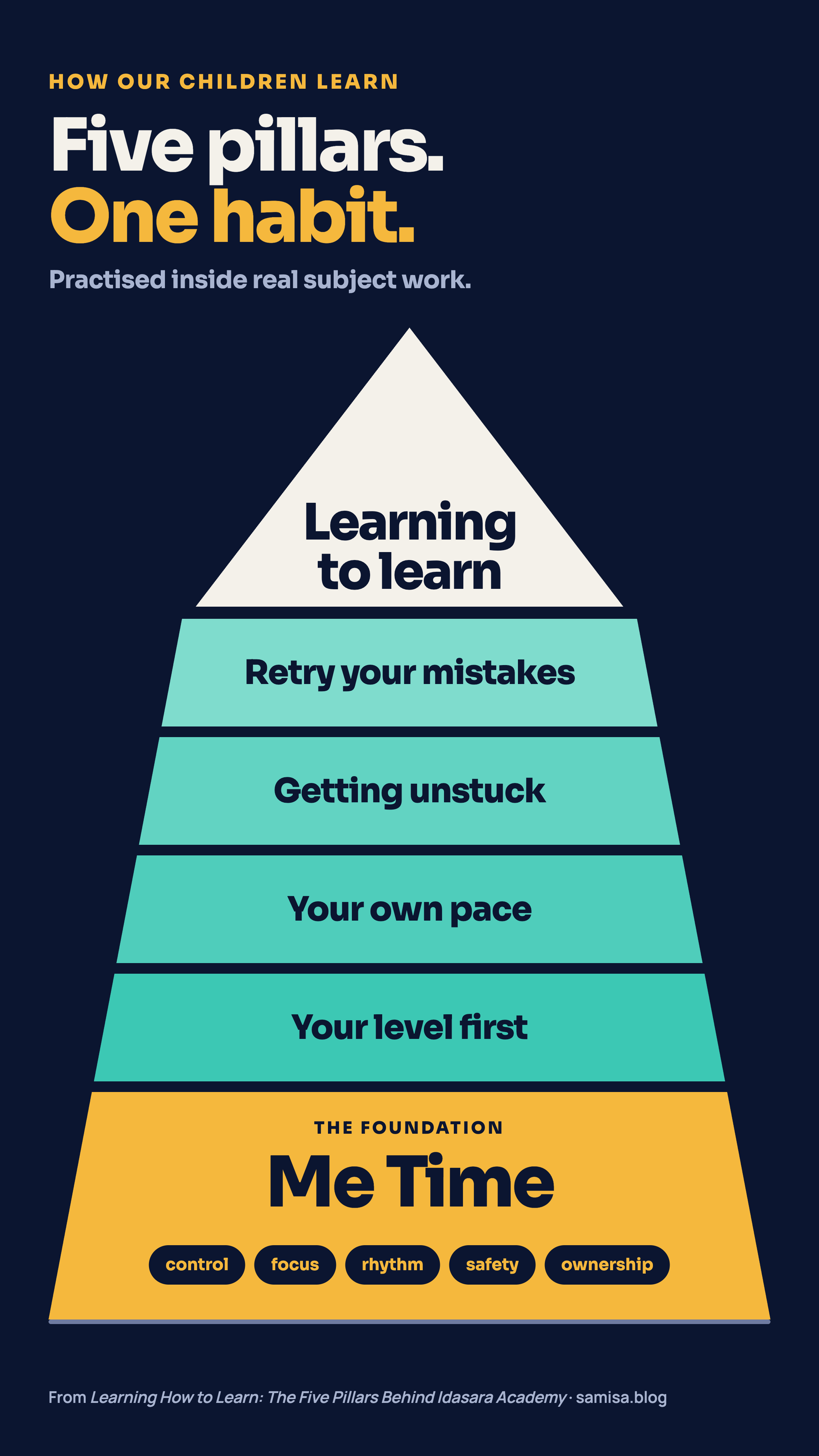
Pillar 1: Me Time. Does a child need control over their own study?
The idea is that learning deepens when the student owns some of it. Me Time is the student’s own study time, and I think of it as control, focus, rhythm, safety and ownership. Safety here means a place where being wrong costs nothing.
Is there research behind it? Some, with limits. A review of 41 studies on choice found that “providing choice enhanced intrinsic motivation, effort, task performance, and perceived competence, among other outcomes.” But the boost to motivation was weaker for choices between options that matter for learning, which is exactly the kind of choice a student makes in their own study time. More control is not automatically better.
On safety, a review of how we learn from errors suggests that, if the goal is to perform well when it counts, “it may be worthwhile to allow and even encourage students to commit and correct errors while they are in low-stakes learning situations rather than to assiduously avoid errors at all costs.” It rests on laboratory studies, and it holds “at least for neurologically typical students”. I have found nothing that measures what Me Time itself does to exam results.
Tonight: let your child choose one subject and decide how long to spend on it. Their own notes, in their own words, and nobody marking them.
What Idasara provides: in Idasara Academy, every student has a Learning Autonomy level: Guided, Shared, Self-directed or Independent. It decides how much the app plans their study and how often it reminds them. A new student starts at Shared. The level is worked out from how they actually study, never from what the family pays, and a student can ask for a step up. There is no score and no comparison with other students in this feature.
Pillar 2: Start at your level. Where should my child begin?
The idea is to teach from where the learner actually is, not where the class or the syllabus says they should be. A gap left behind does not close by moving ahead.
The clearest example I know is Teaching at the Right Level. Children are assessed with a simple tool and grouped by learning level, not by age. In Uttar Pradesh in India, its learning camps doubled the number of children who could read a paragraph or story.
The conditions matter as much as the result. It was foundational reading and maths, run by trained teachers supported by mentors, and it “works best with children in grade three or older”. J-PAL is clear: “Simply training teachers… or providing the teaching materials alone does not improve learning outcomes.” It is evidence for the idea, not for any quiz or app, including ours.
Even the EEF says judging the right level of challenge takes “expert knowledge both of a given subject and of pupils”. A short quiz is a starting point, not a teacher’s judgement.
Tonight: take three questions from last term’s topic and have your child try them cold, without notes. Begin revising from the first one they cannot do.
What Idasara provides: a short five-question quiz on a subject shows a student their weakest topics, weakest first. After sign-up, the gaps from the placement quiz go into their Mistake Bank, and a practice quiz started without picking a topic draws first on what they keep getting wrong.
Pillar 3: Your own pace. Fast, slow, or spread out?
The idea is that understanding takes the time it takes, and that learning holds better when study is spread out rather than crammed.
The spacing part is well supported. A 2013 review of ten study techniques rated practice testing and distributed practice (spreading study out over time) of “high utility”, and underlining and rereading of “surprisingly low utility”.
Having said that, “own pace” cuts both ways.
Mastery learning, where students move on only after showing they have understood, is the obvious partner for “own pace”. Yet the Evidence for Learning toolkit is direct: “the approach appears to be much less effective when students work at their own pace.”
Then there is procrastination. A review of procrastination research found that strong and consistent predictors included “task aversiveness, task delay, self-efficacy, and impulsiveness”. It did not study self-paced courses, but I suspect most parents know the risk: left entirely to their own pace, many children put things off.
And your own pace is not your own “style”: one review found “no adequate evidence base to justify incorporating learning-styles assessments into general educational practice.” Pace, yes. Style, no.
So in our design, freedom comes with guardrails.
Tonight: split one topic into two short sessions on different days. Fix the time for the second session before the first one ends.
What Idasara provides: each day the app suggests a study plan, and how much of it the student can reorder, choose or design grows with their autonomy level. A pace badge shows whether a subject is on track, ahead or needs catching up. It reports pace; it does not set it. Look Ahead lets a student start next year’s subjects early.
Pillar 4: Getting unstuck. What should happen when my child is stuck?
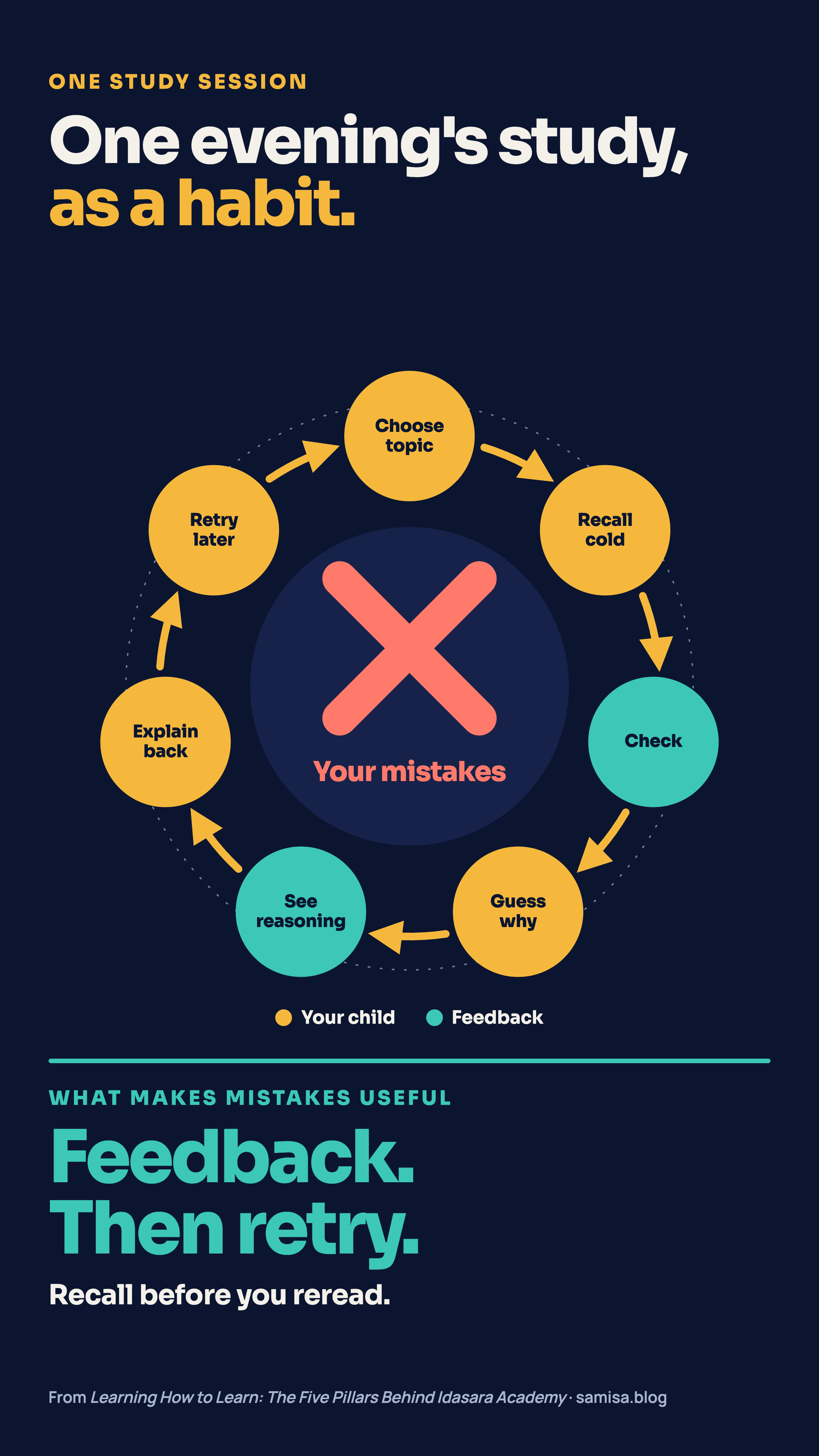
The idea is simple: try first, then help. As I read the research, a stuck child is often helped by having a go first, then seeing the reasoning laid out, then explaining it in their own words.
Across 64 research reports, prompting learners to explain in their own words helped, on average, a moderate amount. A review of 53 studies found that when learning a new concept, trying to solve a problem first and being taught afterwards did moderately better, on average, than being taught first. That trend reversed for second to fifth graders and for general skills, so it is not a rule for every child or every subject.
None of these studies tested an app. Our help comes after a missed question, which is closer to correcting a mistake than to learning a new concept, so I do not claim the research proves our sequence.
Tonight: the next time your child is stuck, ask them to write down their best guess at what went wrong before they look anything up. Then read a fully worked solution together. Then close it, and ask them to explain it back to you.
What Idasara provides: when a student misses a question in a plan quiz, Fix Your Mistakes first asks, “What do you think went wrong?” Then the help grows with the struggle: “Think it through” asks a guiding question on a first miss, “Method hint” points at the method on a repeat miss, and a worked example comes after several attempts. “Show me the full explanation” is always there, so nobody is trapped.
In the AI Study Coach, a student can also switch to Teach It and explain a topic to an AI classmate, who makes a small mistake for them to correct. The coach marks its answers with labels such as “Verified against curriculum” or “Check with your teacher”, and the app says plainly that AI can make mistakes.
I wrote more about using AI without handing it the thinking in Question Everything, With AI.
Pillar 5: The Mistake Bank. Why keep your mistakes?
A mistake tells you exactly what to study next, but only if it is corrected and tried again. A list of mistakes left alone has no research behind it.
The review of learning from errors is clear on what does: “errorful learning followed by corrective feedback is beneficial to learning”, and “Corrective feedback, including analysis of the reasoning leading up to the mistake, is crucial.” The feedback, and the why, are the point.
Then comes the retry. In a classic experiment, students who tried to recall prose passages from memory remembered more two days and a week later than students who simply restudied, “even though repeated studying increased students’ confidence in their ability to remember the material.” Restudying did better on a test five minutes later, and nobody got feedback. It is a laboratory result, not a classroom one.
In simple terms, feeling ready is not the same as being ready. Your child has to pull the answer from their own head. A later review of the testing effect found that recalling an answer helps more than recognising it among options.
Tonight: have your child answer one question from memory and check it. They write down the one mistake and, in their own words, why it happened. Two days later, they try a similar question without the answer beside them.
What Idasara provides: wrong answers from a student’s quizzes collect in their Mistake Bank, filed by subject and topic. A practice quiz started without a topic draws on those first, and a topic drops out once they answer it correctly after reviewing it.
The bank keeps the mistakes. Writing the why and coming back to it is still your child’s habit.
Is this method right for my child?
It suits a child who is willing to own a small part of their study each day, and a family that values understanding over the number of classes attended. It does not replace school or a good teacher. And I will not promise a grade.
Our book and our app aim not to produce “a few 1st places”, rather to make the student, their parents and their family “the 1st” in their own respect. Our book, Learn to Learn, sets out the same habits for students, and I believe the book systematically helps you learn the art of learning.
When you are ready, you will find the book and the Academy at Idasara Academy.
The other three pieces in this set
- Bring Back the Time: What Tuition Hopping Takes From Our Children, on tuition hopping and a child’s time.
- Double Reduction, Five Years On: What the Evidence Can and Cannot Tell a Sri Lankan Parent, on the Double Reduction policy and its lessons.
- AI Does Not Eliminate Good Teachers, on AI, teachers and students.
After all, the habit is the thing that lasts. So start small. Tonight, pick one pillar: write an answer from memory, then keep the mistake. That is your child’s first step to owning their learning.
Sources
- Education Endowment Foundation, Metacognition and Self-Regulated Learning: Guidance Report (v2.4.0).
- Patall, Cooper and Robinson, The effects of choice on intrinsic motivation and related outcomes: A meta-analysis, Psychological Bulletin (2008).
- Metcalfe, Learning from Errors, Annual Review of Psychology (2017).
- J-PAL, Teaching at the Right Level to improve learning (2022).
- Dunlosky et al., Improving Students’ Learning With Effective Learning Techniques (APS summary, 2013).
- Evidence for Learning, Mastery learning, Teaching and Learning Toolkit.
- Steel, The nature of procrastination: A meta-analytic and theoretical review, Psychological Bulletin (2007).
- Pashler, McDaniel, Rohrer and Bjork, Learning Styles: Concepts and Evidence, Psychological Science in the Public Interest (2008).
- Bisra, Liu, Nesbit, Salimi and Winne, Inducing Self-Explanation: a Meta-Analysis, Educational Psychology Review (2018).
- Sinha and Kapur, When Problem Solving Followed by Instruction Works, Review of Educational Research (2021).
- Roediger and Karpicke, Test-enhanced learning, Psychological Science (2006).
- Rowland, The effect of testing versus restudy on retention: A meta-analytic review of the testing effect, Psychological Bulletin (2014).


Leave a Reply