How Our Children Learn: tuition hopping, the Double Reduction policy, learning how to learn, and AI and teachers.
On World Children’s Day, 1 October 2026, I wrote about China’s Double Reduction policy in A Child’s Own Hour, my essay on giving a student one protected hour of their own. I wrote, “I am not holding this up as a model to copy. It was a state mandate”, and I left room for the debate.
This piece is that debate.
Here is where I land. China used a national rule to try to give children their evenings back. The evidence suggests a rule can close tutoring centres and lighten homework, but it cannot, on its own, give a child the hour. Where the rules were enforced hardest, the evening was often filled again, by a different kind of class or by a parent at the desk. That is the lesson a Sri Lankan family can use, and it does not need a law.
One limit before anything else. The policy is five years old, but the research has not caught up. Most of the published evidence covers 2021 to 2023. Two of the most useful papers appeared only in 2026, one in January and one in June, and they point in different directions. I will show you both.
What did China actually do?
In July 2021 the general offices of China’s Communist Party Central Committee and State Council issued the “Double Reduction” rules, aimed at two burdens on children in compulsory education: homework, and off-campus tutoring. Written homework was limited by grade, and subject-tutoring firms were refused new approvals, registered as non-profits and kept out of weekends and school holidays. I set out the detail in A Child’s Own Hour.
Two lines in the policy document matter for everything that follows.
The first is about bedtime. A pupil who still cannot finish their written homework after trying “should still go to bed on time”.
The second is about money. Among its goals, the policy set out to cut household spending on education and the burden on parents “within one year”, and to show “significant results within three years”.
I find that first line moving. A government wrote a child’s bedtime into national policy. Having said that, a sentence in a policy is a promise, not a measurement. So what happened?
Did children’s evenings get lighter?
One large survey of school students in a single city in Guangdong gives the clearest picture we have. The students were asked in April and May 2021, before the rules, and again in December 2021, about five months after them. The survey followed 28,398 students in 152 schools, in Grades 5 to 8 at the start.
The researchers found that the share of students with depression symptoms went from 9.9% to 9.4%, and with anxiety symptoms from 7.4% to 7.1%. The authors say both rates “slightly decreased”. Students who reported less homework, more than eight hours of sleep and more time with their parents had fewer symptoms. A second paper on the same students found that insomnia symptoms fell from 9.9% to 9.2%, again “a slight decrease”.
Notice how carefully I have to say that. It is one group of students, not two studies agreeing. The answers are self-reported. Many students who answered the first survey did not answer the second, and the authors say that calls for caution. There is no comparison group of students without the policy, and the authors say they had no data to separate the effects of COVID-19. The change was not even across the board: in Grade 7, both depression and anxiety symptoms rose. And the authors warn that two surveys eight months apart can show only a temporary change.
In simple terms, the direction is encouraging, the size is small, and the proof is weak.
Did tutoring disappear, or move?
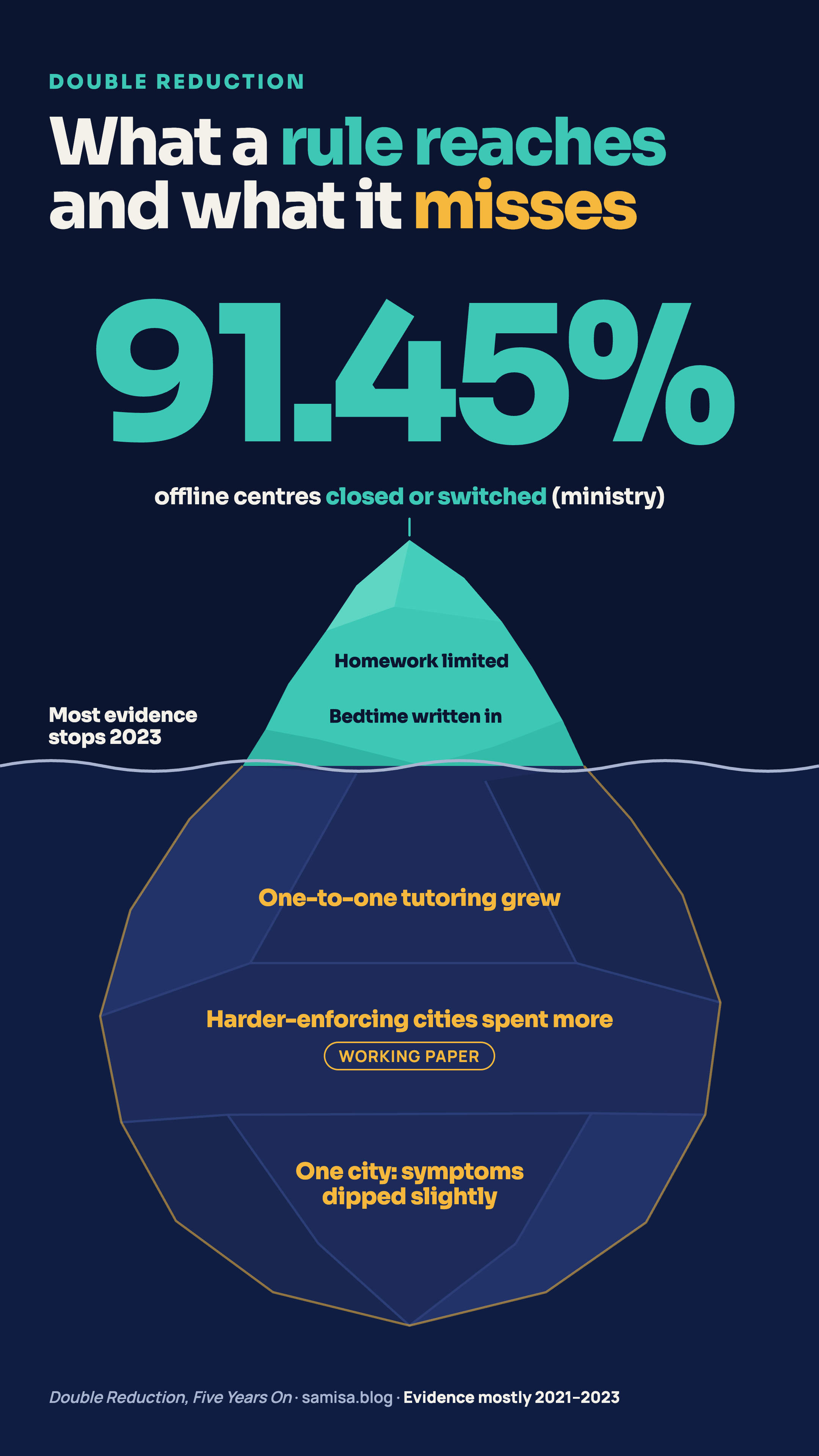
On paper, the tutoring sector shrank fast. By the end of 2021, according to ministry data reported by China Daily, “91.45 percent of offline tutoring centers and 87.07 percent of online tutoring services had closed or switched to other businesses”. The same report, citing China’s vice-minister of education, says the ministry “cracked down on summer or underground tutoring activities”. “Underground” is the ministry’s word, as reported, not mine.
In October 2024, Reuters reported that tutoring had “continued to exist in various forms”, sometimes sold under other names, with maths offered as “logical thinking”. In its words: “One-on-one tutoring… flourished as parents who could afford the higher prices hired tutors to come to their homes.” Reuters also described a quiet easing of enforcement in 2024, with “no formal acknowledgement of a change in policy”.
So many centres closed. Did the demand?
Did families spend less?
This is the question I care about most, because it was one of the policy’s own goals.
A January 2026 working paper, not yet peer-reviewed, based on an online survey of about 10,000 mothers in 2023, compared cities that enforced the rules harder with cities that enforced them less. Families in the cities that enforced the rules harder were a few percentage points more likely to buy private tutoring, mostly one-to-one. Compared with families in the cities that enforced the rules less, their spending on tutoring went up, not down. Parents there also spent more of their own time on homework.
Children’s average performance, the authors found, “remained unaffected”. For the poorest families, the picture was different. Families in the lowest income quarter did not add tutoring, their children’s performance declined, and those parents spent much more time helping with homework.
The authors’ phrase for what happened is that parents “turned to the less enforceable parts of the policy”. They are also fair to it: they write that “schools did reduce students’ homework, and many private tutoring institutions were shut down”.
My own reading is simple. A rule can bind a firm. It cannot bind a worried parent.
Did the gap between rich and poor children grow?
Before you take that working paper as the verdict, read the other one.
A peer-reviewed paper published in June 2026 used a national survey that follows the same families over time, with data from 2020 and 2022. It found that the gap in achievement between urban and rural children narrowed, and that a family’s social and economic standing mattered less to a child’s results than before. Its own conclusion is careful: “notable inequalities persist”. I have read its summary, not its full text, and its data stop at 2022.
So which is it?
The two papers do not measure the same thing. One asks mothers about tutoring and spending in 2023. The other follows achievement across the country up to 2022. Both can be partly right. The evidence points both ways, and most of it stops at 2023.
Anyone who tells you the policy simply worked, or simply failed, is telling you more than the evidence knows.
What does Sri Lanka already have?
Less than many people assume, and more than nothing.
In February 2026, the Department of Examinations banned all tuition classes for the 2025 G.C.E. O/L examination, including lectures, seminars, workshops and promotion, from midnight the next day until the exam ended, and warned of legal action against anyone who broke it. That covered the run-up to one exam, not tuition in general.
In January 2019, a committee appointed by the President was to discuss a ban on tuition on Sundays and Poya days. Religious leaders asked for at least a four-hour ban on Sundays and a full ban on Poya days. The Education Minister said the plan “was only in discussion”. Teachers’ unions pushed back. One union’s general secretary called it “an impractical stunt”. Another union’s leader argued that A/L students could not reach a university entrance score high enough for a state university place without extra classes.
I could not confirm that any Sunday or Poya rule is in force today.
Should we do the same?
I am not calling for a ban. The evidence from China is too mixed, and I do not believe a foreign mandate is the right starting point for our children.
Still, I want to be honest about the strongest argument against my own position. That teachers’ union leader had a point. Where one exam decides a university place, a family that steps back alone can feel it is letting its child fall behind. A law tries to change the rules for everyone at once. A single household cannot do that.
I take that seriously. It is why I am not asking any family to drop the class it trusts. I wrote more about how the hours fill up, one class at a time, in Bring Back the Time.
What can a family take without a law?
Look again at what the Chinese evidence suggests. Taking something away did not, by itself, give the child the hour. Where homework and classes were cut, the space was often filled again: by one-to-one tutoring for families who could pay, and by parents at the desk for families who could not.
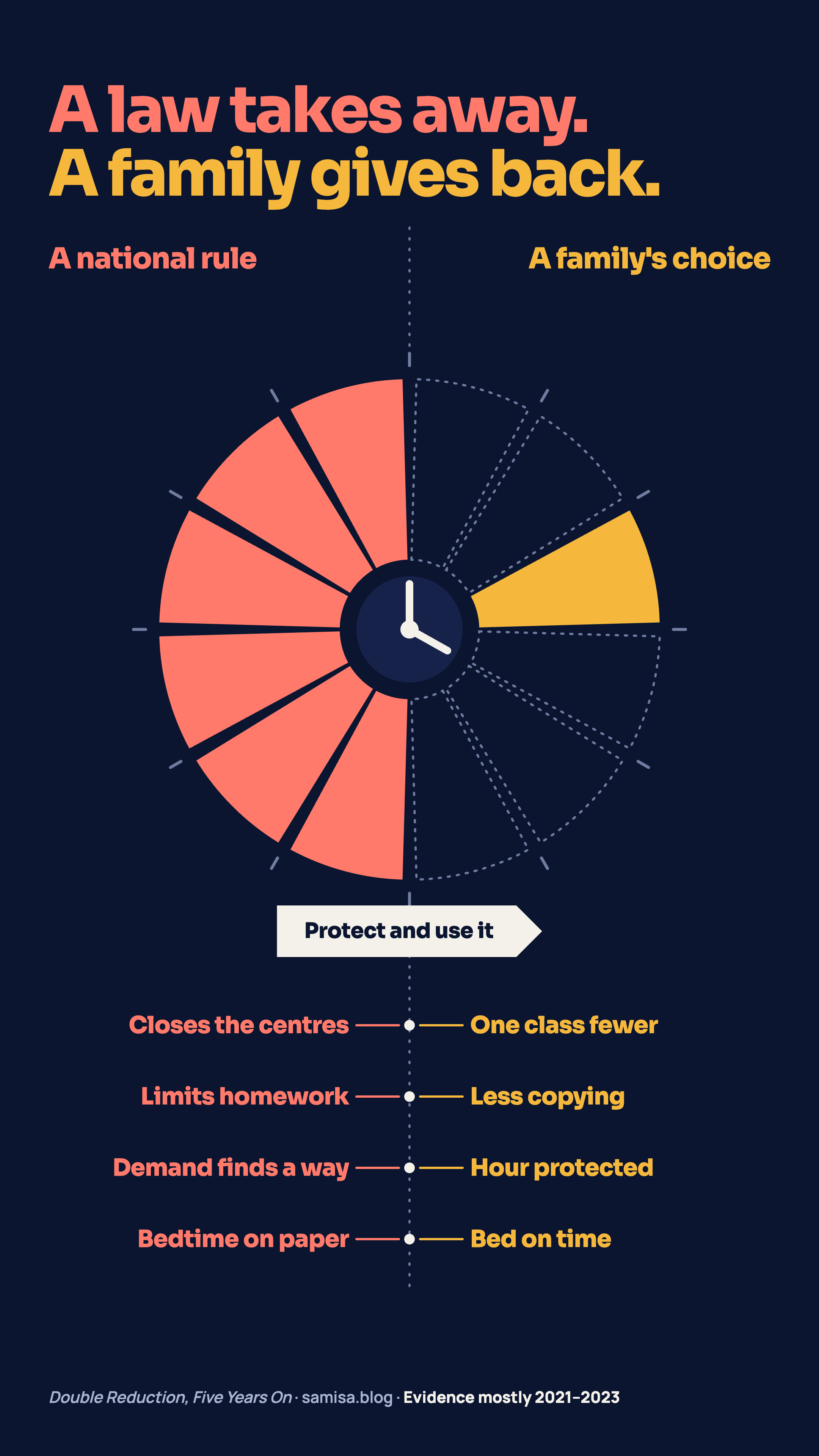
That changes how I think about my own advice. In A Child’s Own Hour I wrote, “A family can make them at the dinner table, by choice”, meaning the two reductions: less receiving, less copying. I still believe that. But the evidence adds a second half I had not said clearly enough.
A reduction only helps if the hour it frees is protected, and used by the child.
Protected, so it is not quietly refilled by another class or another worksheet. Used, so the child spends it alone with a subject, writing from memory, testing themselves, finding their own mistakes. And when the work cannot be finished after honest effort, the child should still go to bed on time. That line from the policy is the easiest part to copy, and it costs nothing.
Where does Idasara fit?
I have built Idasara Academy on one belief. Classes deliver material. Learning happens in the hours a student spends alone with a subject. In Learn to Learn I call these hours Me Time, and I explain the idea more fully in Learning How to Learn.
Idasara Academy is built around those hours: a daily study plan, short notes and flash cards, and an AI study coach.
It is one route a family can choose at home. It is not a substitute for policy, and it promises no results. What it offers is a way to use the hour once you have protected it.
What can you do this week?
Pick your family’s two reductions.
One class or task fewer, chosen together with your child, and only one you are sure they can do without. And one hour a day that belongs to the child: their subject, their pen, no one else running it.
Then add the line China wrote into its policy. If the homework is not finished after an honest try, your child should still go to bed on time.
A country needed a national rule to try this. You need a conversation at the dinner table. Start it this week, and see what the hour gives back.
Sources
- General Office of the CPC Central Committee and General Office of the State Council, Opinions on further reducing the homework and off-campus training burden of students in compulsory education (24 July 2021), gov.cn. Clauses 3 (goals), 5 (homework), 8 (bedtime), 13–14 (tutoring firms and holidays). English quotations from this document are my translation.
- China Daily via gov.cn, Proposals help ensure easing of students’ academic workload (25 Feb 2022). Ministry figures on tutoring closures.
- Wang et al., Has the “Double Reduction” policy relieved stress?, Child and Adolescent Psychiatry and Mental Health (2022).
- Zhang et al., Changes in insomnia symptoms among compulsory education students in China after the “Double Reduction” policy: a two-wave longitudinal study, BMC Psychiatry (2024). Same students as source 3.
- Liu, Meng, Pan and Zhao, Unintended Consequences of China’s Double Reduction Policy, RFBerlin Discussion Paper 034/26 (19 Jan 2026). Working paper, not peer-reviewed.
- Gui and Alam, Does the Double Reduction Policy Mitigate the Academic Gaps Caused by SES and Urban-Rural Settings?, Education and Urban Society (25 June 2026).
- Reuters via VOA, China’s private tutoring firms emerge from the shadows after crackdown (28 Oct 2024).
- Newsfirst, Exams Dept imposes ban on O/L tuition classes (10 Feb 2026).
- The Sunday Times, Sparks fly over tuition ban plan on Sundays, Poya Days (20 Jan 2019).


Leave a Reply