AI, Human Agency and the Digital Economy · Part 18 of 41
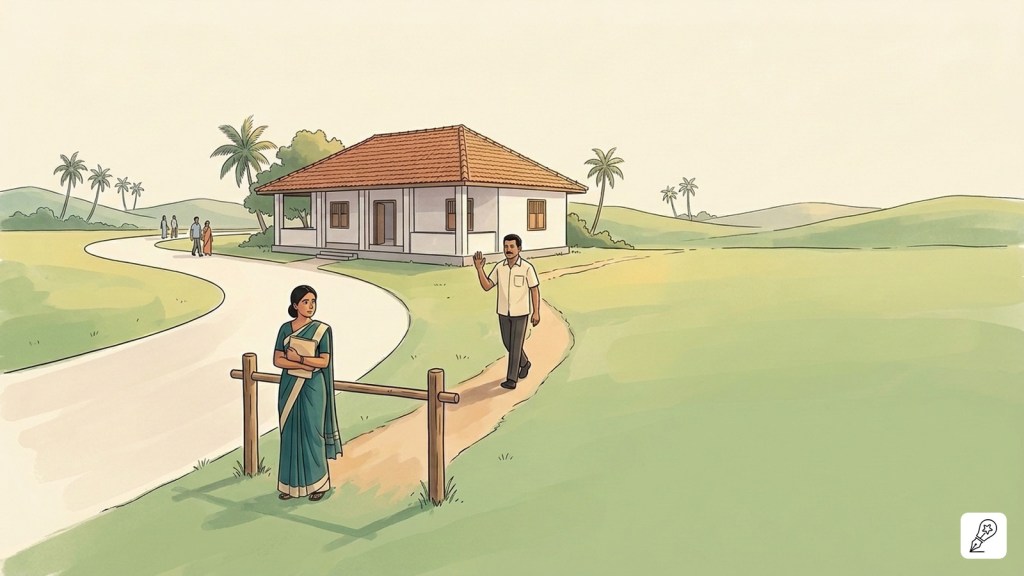
A woman reaches the counter with every document the notice asked for. The officer turns the screen towards her: her father’s name is spelled one way in the record that proves the land is his, and another in the record that proves she is his daughter.
Both records are internally correct. Both institutions did their work properly. And she is the one who goes home and comes back.
The portal was up; nothing there is a technology failure. On the dashboard that transaction is not a failure either — it is simply not there, because she never finished it.
So: when the record is wrong, who is waiting, and whose desk is the problem on?
The companion essay, Let Information Move So Citizens Do Not Have To, follows a constructed journey — an imagined application, assembled for argument — in which shared capabilities remove repeated visits. This one is about everything off that path: the missing record, the conflict, the correction, the appeal, the counting.
One rule governs it: do not imply all records are accurate, digitised or available through interfaces. Citizen experience depends on the complete service, including records, procedures, staff, exception handling and recovery.
What happens when the record is missing?
Not corrupted, not disputed — simply not there in any form a system can reach.
The World Bank Group’s March 2025 white paper on digital public infrastructure names “difficulties in phasing out legacy systems” and the “persistence of temporary or stopgap solutions… proliferation of data silos” among the recurring conditions of this work — a global synthesis, not a country evaluation, and not about Sri Lanka.
So the question is not whether a record will be missing, but who owns the case on the morning one is. My proposal, and only that: a named human owner and a written route for every exception, settled before launch. An unowned exception is a design decision nobody wrote down.
What happens when two records disagree?
Here the law does more than I expected, and less than the situation needs.
More, because a rectification right already exists. Under section 15 of Sri Lanka’s Personal Data Protection Act (PDPA), No. 9 of 2022, a person may require a controller, in writing, to rectify or complete inaccurate or incomplete personal data — subject to section 17’s refusal grounds. Anyone who says Sri Lanka has no correction right is wrong; I had it wrong until I read the section.
Less, because it runs against one controller at a time. At the counter, two institutions each hold their own record correctly and disagree. Which is authoritative? Who decides, on what evidence, by when?
I found no published Sri Lankan process for resolving a disagreement between two registries, and I will not invent one. What I would write instead — my recommendation, not a rule anyone has issued — is narrower: name the authoritative record, and the officer who decides when it is contradicted.
What the law gives, exactly — and what it does not
Section 18(1) of the PDPA, expressed to be “subject to section 19”, gives this: “every data subject shall have the right to request a controller to review a decision of such controller based solely on automated processing, which has created or which is likely to create an irreversible and continuous impact on the rights and freedoms of the data subject” under the Constitution or any written law. The words “the Constitution or” were added by the Personal Data Protection (Amendment) Act, No. 22 of 2025.
The right is bounded on four sides (s.18(2)): it does not apply where the automated decision is authorised by written law; authorised in a manner determined by the Data Protection Authority; based on the person’s consent; or necessary for a contract with the controller.
Read the last two again: they are the grounds a consent-based exchange platform is most naturally built on, so a service designed the obvious way can sit outside the right it looks covered by. My reading, not a finding of any court.
An appeal route exists too: where a controller refuses such a review, the person may appeal to the Data Protection Authority — section 19(1)(f), as substituted by the 2025 amendment — and either party aggrieved by the Authority’s determination may appeal to the Court of Appeal within thirty days (s.19(5)).
On commencement I am careful: the Authority’s published dates-of-operation notice gives 18 March 2025 for Part II, which holds these sections, and whether that survives the 2025 amendment I cannot resolve. I cite the Act and the notice, and claim nothing about enforcement practice.
Now the limits. This is personal-data machinery: it acts against a controller holding your data, not between two institutions. Section 18(1) bites only on a decision “based solely on automated processing”, so a service that keeps a person as the decision point — how I would build one — sits outside it. And for a service decision that is not a personal-data decision, I found no appeal route.
This is where such an essay produces a workflow: three steps, a form, a target, an escalation ladder. I could write it and it would read well. It would also be fiction. The statute confers rights; it does not describe an operating mechanism. I cannot tell you which desk receives the request, how long it takes, or how often it is used — none of it is written down anywhere I could find. Fluency here would be the lie.
Where AI belongs here is narrow: pulling from approved documents grounds an answer better, and guarantees nothing about the interpretation or output. AI never decides eligibility and never resolves which record is right — my rule, not the law’s.
Is there an appeal institution to learn from?
There is one, and its value is its honesty.
The Right to Information Commission is an information-access body, not the appeals route for a service exception, and I will not present it as one. It is instructive anyway, because it publishes an account of itself. That account for 2024–2025 states: “The compliance by the Government of Sri Lanka has been extremely poor in respect of all these mandatory statutory requirements since the Act was operationalized in 2017.” No compliance rate is published; that is the regulator’s own characterisation, and I attach no number to it. The same document records 36 appeals pending before the Court of Appeal at end-2024, most filed by public authorities challenging the Commission’s own decisions.
Working, and visibly strained — the caution against my own recommendation. An owner without capacity is still a person waiting; who puts it right, at whose cost, I return to later.
“But exceptions are rare”
Design for the ninety-five percent and handle the rest by hand. That is what the counter is for.
The first answer: the exception is not rare for the person inside it — one hundred percent of her experience of the state that week.
The second matters more. A manual fallback nobody designed is not a fallback; it is an unmeasured queue. Nobody can say how many are in it, how long they wait or who they are — so nobody can say it is five percent. “Exceptions are rare” is an assumption wearing the clothes of a measurement.
The answer to a rare exception is a count, not a speech.
Measure completion, effort, reliability — and who is still failing
The clearest definitions I know are British — method, not a rule that applies here. UK central-government guidance puts it plainly: “Your service’s completion rate is the number of digital transactions that your users complete as a percentage of all digital transactions that your users start.” Visits to a website, it adds, are not transactions.
Set that beside an availability report and the difference is the argument. Available counts the door. Completion counts the people who got through it.
The same guidance requires four indicators to be published: “cost per transaction; user satisfaction; completion rate; digital take-up.” One aside against my own case: the platform that published them centrally closed in March 2021 — the duty survived, the shop window did not.
Effort is the cost side: total cost, “including assisted digital support costs”, divided by completed transactions, not started ones. A second visit is a cost of the service, not one the citizen absorbs. And people helped by someone else — “known as ‘assisted digital’ support” — count inside take-up. They still completed.
Reliability is where dashboards stop too early. The UK service standard asks teams to “monitor outcomes for users and ethical issues such as bias, not just technical faults” — uptime and bias as two properties of one word. It gates growth on capacity too: before public beta, a team must show “support staff can cope with new users who might struggle to use the service, including in ways you have not foreseen”. Scaling past your exception capacity decides how many wait.
Unequal outcomes is the only one with Sri Lankan numbers. The Department of Census and Statistics reports digital literacy at 72.0% nationally, 81.1% urban and 58.5% in the estate sector — Computer Literacy Statistics 2025 Annual Bulletin, about 25,000 households, ages 5 to 69, January to December 2025, with coefficient-of-variation cautions on its tables. A national average conceals a twenty-two-point spread.
And the admission this section stands on. I found no published Sri Lankan completion rate, cost per completed transaction or take-up figure for any government service in any source I checked, and I will not borrow a foreign number and pass it as local. That absence is not a weakness in the argument for measurement — it is the argument.
The list I would write down
Not a framework. One page per service, signed by someone.
| Case or measure | What exists | What I would add (my proposal) |
|---|---|---|
| Record missing | None published that I found | The officer who owns it, and the manual route |
| Registries disagree | None published that I found | Which record is authoritative, and who decides |
| Correction | PDPA s.15 — personal data only | The desk that receives it, and how long it takes |
| Appeal | PDPA s.19(1)(f), then the Court of Appeal in thirty days — solely-automated personal-data decisions only | What a citizen does when it was not solely automated |
| Completion | UK guidance | Publish it per service, monthly |
| Effort | UK method | The second visit, costed to the service |
| Reliability | UK standard | Exception volumes and clearance times, beside uptime |
| Unequal outcomes | 72.0% national, 81.1% urban, 58.5% estate | Every measure above, broken by district and sector |
The part a platform cannot carry
Shared foundations can reduce duplication while leaving service owners accountable for outcomes — and that second clause is the design constraint. A platform carries the integration, never the accountability; a correction request must land on a named desk, not on an architecture.
Shared infrastructure earns its value when it reduces unnecessary citizen effort while preserving authority and rights — and rights means what a person can exercise on the day it goes wrong, not what sits in an unused section.
One question, then, for the service you are responsible for. Last month, how many people started it and did not finish — and can you say anything about who they were?
If nobody counts, that is not a reporting gap. That is the exception path — and someone is standing in it right now.
This is the eighteenth essay in a series asking how people, organizations and nations can turn increasingly capable AI into greater human capability, better services and sustainable economic opportunity.
Next in this series: A17 — Give Public Officers a Practical Route from AI Use to Service Improvement
All essays in this series: AI, Human Agency and the Digital Economy
Sources
- Personal Data Protection Act, No. 9 of 2022 — Parliament of Sri Lanka (PDF), certified 19 March 2022. Section 15 (rectification), section 18 (review of a solely-automated decision, and its four exceptions) and section 19 (appeals) as quoted above.
- Personal Data Protection (Amendment) Act, No. 22 of 2025 — Data Protection Authority of Sri Lanka (PDF), certified 30 October 2025. Substitutes section 19(1)(f) and amends the wording of section 18(1). The amendment’s own date of operation is not asserted here.
- Dates of operation of the Act — Data Protection Authority of Sri Lanka. The published commencement notice relied on for Part II. Cited as the Authority’s notice; no claim is made about enforcement practice.
- Recent notable developments, 2024–2025 — Right to Information Commission of Sri Lanka (PDF). The “extremely poor” compliance characterisation and the 36 appeals pending before the Court of Appeal at end-2024. The Commission’s own published words; no compliance rate is published.
- Measuring completion rate — GOV.UK Service Manual. The definition of completion rate quoted above, and the rule that website visits are not transactions. UK central-government method, not a Sri Lankan rule and not a finding about any population.
- Data you must publish — GOV.UK Service Manual. The four mandatory key performance indicators, and the note that the Performance Platform closed in March 2021.
- Measuring digital take-up — GOV.UK Service Manual. Assisted-digital users counted inside digital take-up.
- Measuring cost per transaction — GOV.UK Service Manual. Total cost including assisted-digital support, divided by completed transactions.
- Service Standard point 14: operate a reliable service — GOV.UK. “Monitor outcomes for users and ethical issues such as bias, not just technical faults.” A process standard, not evidence of any outcome.
- How the beta phase works — GOV.UK Service Manual. Expansion gated on support staff being able to cope with users who struggle, “including in ways you have not foreseen”.
- Computer Literacy Statistics 2025 — Annual Bulletin — Department of Census and Statistics, Sri Lanka (PDF). Digital literacy 72.0% national, 81.1% urban, 58.5% estate; about 25,000 households, ages 5–69, January–December 2025. Coefficient-of-variation cautions are printed in the bulletin; sector figures, not evidence about any single service.
- Digital Public Infrastructure and Development: A World Bank Group Approach — World Bank Group, Digital Transformation White Paper Vol. 1, March 2025 (PDF). “Difficulties in phasing out legacy systems”; “persistence of temporary or stopgap solutions… proliferation of data silos”. A global synthesis, not a country evaluation and not about Sri Lanka.


Leave a Reply