AI, Human Agency and the Digital Economy · Part 39 of 41
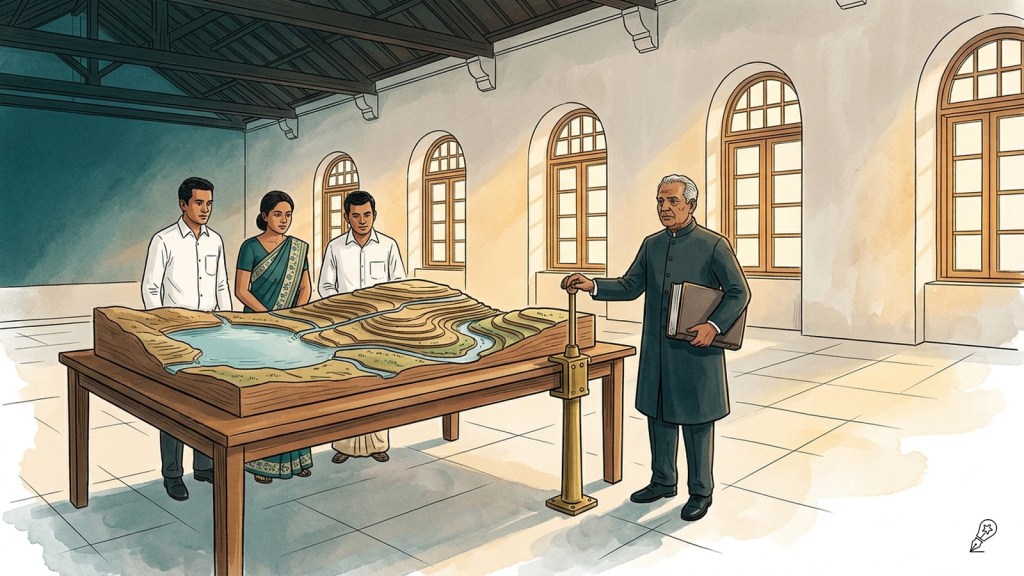
A team shows you a model of a region. It reproduces last year’s behaviour almost exactly — peaks in the right weeks, shortfalls in the right places — and the room relaxes, because it agrees with reality.
That is the moment I want to slow down.
Reproducing what already happened is a real test, and a weaker one than it feels. Nobody in the room can name the missing variable — missing variables do not announce themselves. That is what makes them missing.
So, two questions. What can validation never settle? And who is allowed to say no?
The layer of my own proposed architecture this sits in — context models, federated knowledge, simulation and bounded optimization — is, in my own words, an ambitious proposal requiring validation. The terms, the bounded case and the question of who keeps shared data true are set out in the piece before this one; nothing here depends on having read it.
What a model that fits cannot tell you
One finding in the modelling literature, from the same domain as water, deserves to be better known.
Keith Beven, in A Manifesto for the Equifinality Thesis, states it directly: “there are many acceptable representations that cannot be easily rejected and that should be considered in assessing the uncertainty associated with predictions.” And then: “The dominant uncertainty lies in how to map the real system into that space of feasible models.”
That is not a point about error bars. Beven writes about hydrological and environmental modelling, where several different representations of one system each survive the same record. The copy I read is his eprint in Lancaster University’s repository, which carries no journal title or date on its face, so I claim no more than I can see.
The reading across to a planning model is mine, not his. If several structurally different models all reproduce the record and then disagree about the decision in front of you, validation has not chosen between them. It has told you only which ones you cannot yet rule out.
Which is why no model represents the whole country reliably is a claim here, with a reason attached — not a mood.
The validation plan I would ask for
Keep the constructed example this pair uses: a bounded simulation of water allocation in one region, answering one stated planning question. It is invented for the argument — no basin, no agency, no figures.
What would I want written down before it ran? My proposal, not a standard.
Hold back periods of observed behaviour the model has not seen, predict them, and publish the misses beside the fits; a validation report containing only agreement is a brochure. Build more than one structure, not merely more than one setting of the same one, and where the rivals disagree about the decision, report the disagreement as the finding.
Then the four things easiest to leave out. What is wrong with the inputs, stated before what the model found — the gauges that failed, the months that are estimates. How the model will change the system it models — once decisions follow it, last year’s fit stops being evidence. Who goes short: an allocation is a political choice, and a model can lay out consequences without making that choice or carrying it. And a named owner for maintenance before the build, because a model nobody is funded to maintain does not stop working — it goes on being confidently wrong, on a schedule.
And the line that makes it a test at all: write down, before the run, the result that would stop the programme. A test that cannot fail is not a test.
What I am not proposing
Four refusals, each with the mechanism that holds it up.
I refuse the person-level record. The unit of analysis is a zone, a flow, an asset, a period — never a person. The mechanism is the request itself, not a policy: the institution is asked for quantities by zone and period, so no identity field is joined in and there is nothing to re-identify later. A planning model becomes surveillance the moment its unit of analysis changes from a place to a person, which is why the line lives in the query schema, where the person-level question has no field to answer it — not in a document a later administration can revise.
I refuse the single national store. Nothing is consolidated into one repository a later purpose could be pointed at. Each answer is computed against the record its institution still holds, and the model keeps the answer, not the record. There is no master copy, because there is nothing to copy from.
I refuse repurposing. Purpose is a property of each grant of access, not of the system: a grant names the question, carries an expiry, and a new question needs a new grant — decided by someone who does not own the programme, written to a log the owner cannot edit. So a later proposal to use the model for enforcement cannot arrive as a configuration change. It arrives as a new request, in the open, where it can be refused.
I refuse automated intervention on an individual. Outputs go to a named official with authority to act; where an output would land on a household, a person decides and signs. “Bounded optimization” is my own phrase for this layer, and it carries a hard limit: use autonomous actions only within explicit authority and tested operational limits. A system that acts on a household by itself is outside those limits by definition — including when the definition is mine.
None of that is a caveat. A caveat is what you add so a proposal survives the meeting; a specification is what the build has to satisfy, and the list of what a system may never hold belongs in the proposal, not the apology afterwards.
Scrutinised by whom, decided by whom?
An oversight body you appoint, that asks your permission before it looks, is not scrutiny. It is a second opinion from a subordinate.
Sri Lanka already has the shape of an answer, in a much older institution. Section 3(3) of the National Audit Act, No. 19 of 2018, certified on 17 July 2018, says it plainly: “The Auditor General shall be responsible to Parliament in carrying out the provisions of this Act.” The Act’s scope, in section 3(2), “includes examining the accounts, finances, financial position and prudent management of public finance and properties of auditee entities” — public-finance audit, not data governance.
Read it with its limits attached. Commencement is left to an Order of the President; I could not locate that Order, so I claim nothing about when the Act took effect. That the office therefore does not answer to the ministry whose spending it examines is my reading of that duty, not a sentence in the Act — and reading any of it as an answer to who scrutinises a twin’s owner is my extension of it, not the Act’s.
The principle is worth copying: the scrutineer answers somewhere the scrutinised body cannot reach. Three things follow, and they are mine to propose. Access to inputs, model versions and logs without the owner’s permission. Standing to require a stop. Findings published, not returned to the owner for comment.
On authority the line is short. Digital twins support analysis; they do not automatically acquire an official’s legal authority or model all relevant human circumstances.
Two consequences. A model’s generated reasoning is not an authoritative audit trail — the record carries sources, rule versions, actions, approvals and state. And retrieval from approved documents can improve grounding; it does not guarantee correct interpretation or output.
That a person must be able to correct what an institution holds, and contest a decision that lands on them, is not in question here; how that works is argued elsewhere in this series.
The test I would run before the money moves
What I want from all this is something a commissioner can use in a meeting: four columns, and a test capable of returning no. Mine, not a standard.
| The question the twin is for | What it may never hold | What validation would have to show | Who can stop it |
|---|---|---|---|
| One resource, one region, one stated question | Any person-level record; any identity field in the query | Held-back periods predicted, misses published, rival structures reported | A scrutineer outside the owning body, with log access and standing to stop it |
| Several sectors, each with its own question and grant | A joined record across sectors; any purpose added without a new grant | The same, per question — one passing model does not license the next | The same, plus a named official signing each consequential decision |
| “National intelligence”, purpose to be determined later | Unanswerable: with no purpose, nothing is excluded | Nothing: with no question, there is no observed behaviour to validate against | Nobody, by construction |
Fill in the fourth column first. If it is empty, the answer is no, whatever the first three say. A pre-commitment test for one proposal, not a portfolio instrument.
“Every other country is building one”
The strongest case against all of that, in its own words: Every other country is building one. Your caution is how we stay behind.
I concede most of it. The planning problems are real, expensive and getting harder. A model that lays out consequences without choosing beats a meeting where the loudest district wins; a country that models nothing decides by anecdote, which has biases too, just older ones.
Here is where it is wrong. The failure mode of these programmes is not excessive caution. It is unbounded scope. A twin commissioned for water quietly becomes a record of people, then cannot be validated because nobody can say what question it answers, then cannot be defended when a serious person asks, then is switched off after the money is spent. Bounded is not the slow path; it is the only version that survives its first hard question.
Having said that, I owe you the limit of my evidence. I have no comparative evidence that a bounded programme elsewhere has delivered, stalled or been abandoned; I looked and did not find it. So take that as an argument about failure modes, not a measured result.
What I would hold to
Ambition should be paired with staged implementation and explicit uncertainty.
I am not arguing anyone out of the instrument. I proposed this layer myself, and I would still like to see a bounded version built here, on one real question, by people who publish what it got wrong.
The refusals are not the price of the ambition. They are what make it legible: to Parliament, to a scrutineer, to the household a decision lands on.
So when the next proposal arrives — a region rendered beautifully on a screen — ask the last question first. Not what can it do. Who can stop it, and what has it been built so that it can never hold?
A proposal that cannot answer those is not too ambitious. It is unfinished.
This is the thirty-ninth essay in a series asking how people, organizations and nations can turn increasingly capable AI into greater human capability, better services and sustainable economic opportunity. It is the second of four companion essays, which sit beside Parts I–VI rather than after them.
Next in this series: C02 — When Agents Act for Us in the Economy
All essays in this series: AI, Human Agency and the Digital Economy
Sources
- A Manifesto for the Equifinality Thesis — Keith Beven, author eprint, Lancaster University repository (PDF). Both quoted strings. Hydrological and environmental modelling. The eprint carries no journal title, volume, page range or year on its face, so none is asserted here. The reading across to a planning simulation is my extension, labelled as such in the text.
- National Audit Act, No. 19 of 2018 — Parliament of Sri Lanka, certified 17 July 2018 (PDF). Sections 3(2) and 3(3), quoted. Public-finance audit scope; the Act does not name data governance or any modelling programme. Commencement is left to an Order of the President under section 1(2); I could not locate that Order and make no claim about the date of operation. Applying the Act’s answerability principle to a hypothetical twin programme is my argument, not the Act’s. Section 2 applies “the provisions enshrined in Articles 153, 153A, 153B, 153C, 153D, 153E, 153F, 153G, 153H and 154 of the Constitution” to audits of auditee entities — the office is constitutional and older than this Act, which is what “a much older institution” refers to in the text. Article 153 itself is not quoted here: I read the Act, not the Constitution.


Leave a Reply